I’ve often wondered where my curiosity about languages came from. I took took two years of French and then a year of Spanish in high school. And then, when they wanted to start me in a sophomore level French class in college, I decided I’d rather start over again with something else, so I said, I’ll try Russian instead! So I took two years and then decided that I’d rather do art than languages and went off on that tangent for my eventual degree.
My dad is a native Spanish speaker, but will admit that he only had about a 6th grade education in Spanish, because after that they came to the States for school and only spent holidays in Guatemala. I remember him speaking Spanish with his mother almost exclusively, and we would all laugh when they would talk about maybe what we were going to do that day and then ask me if that sounded okay and I would reply in English, having fully understood the conversation up to that point. It was like this beautiful background music to my childhood and when I had to study it in a classroom it wasn’t nearly as much fun as Russian, but I still think if I were to do one of those immersion programs, even at this point in my life, I would probably get pretty fluent pretty quickly, at least conversationally.
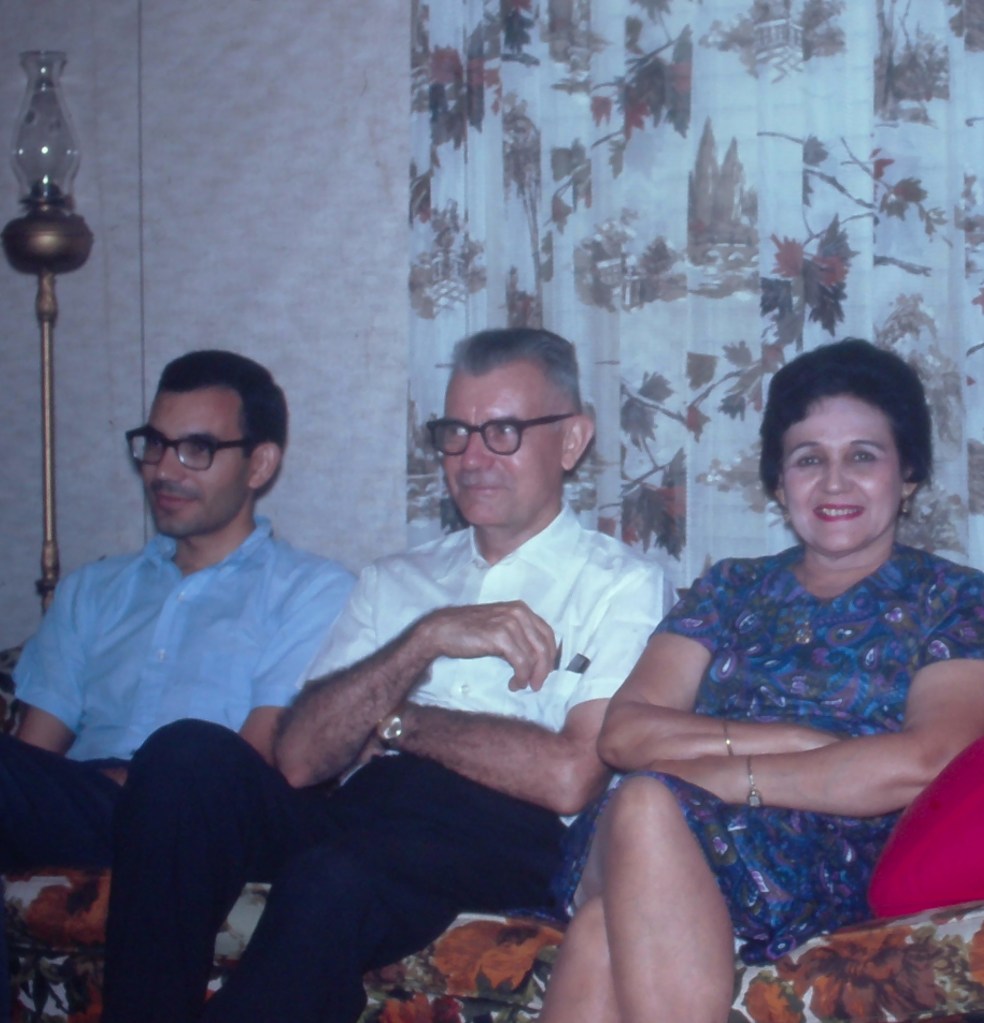
My dad and his parents, all Spanish speakers.
In contrast, my mom’s mom’s family, all descended from native speaking Swedes, never really spoke Swedish themselves. Many of the cousins in my grandmother’s generation still used some Swedish words and phrases (and even a Swedish blessing over the meal at gatherings) and they remembered their older relatives speaking Swedish in the home and at church, but in their generation – one or two removed from the old country – it had mostly been lost.
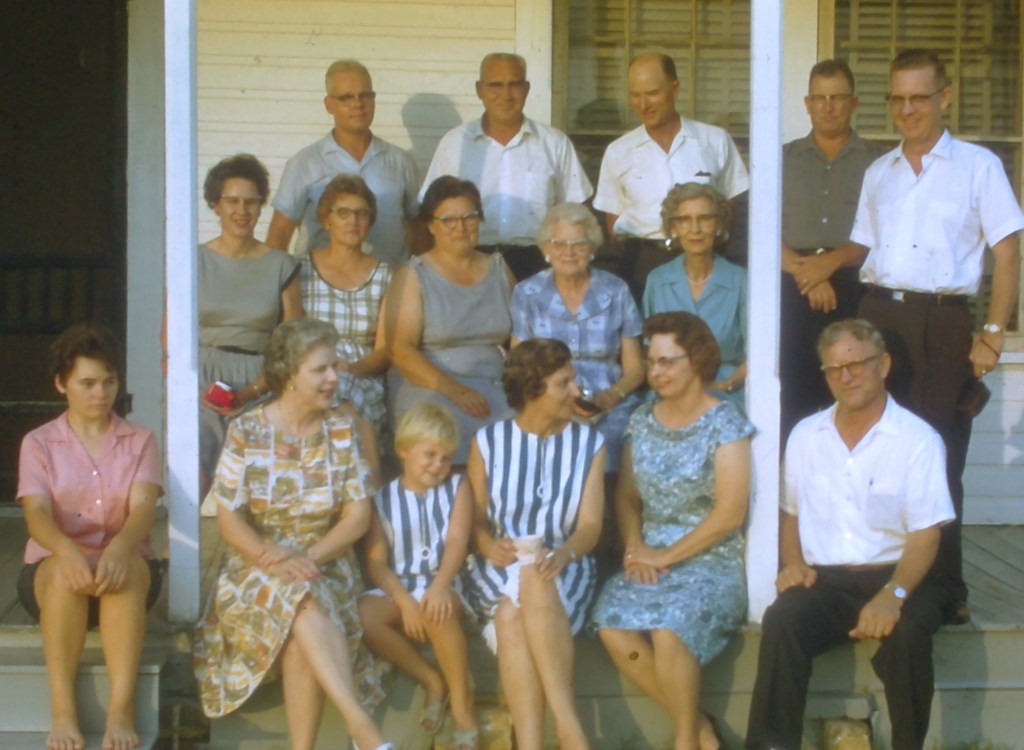
Swedes on the porch at Happy Hollow, Georgetown, 1964. Ruth and Irene, seated in the center, both in blue with gray hair, would have probably spoken Swedish with their elders.
Who knows what might have happened to the language processing centers of my little brain if I had heard English, Spanish, and Swedish spoken regularly during my childhood. The science of brain development says the language acquisition centers are wide open from birth to about 5 years. I might be a multilingual translator at the UN at this point! Anyway, that curiosity about languages has made it easier to figure out how to translate and interpret the Swedish Church Records. Also on the list for future research efforts is to see if I can help my dad with some of the Guatemala research, although those records are about as few and far between as Irish records, so that’ll be a big challenge!
I wrote about my great-grandfather Jack (Aubrey) Adams and his name change back in Week 2 , but I have plenty of other candidates for this week’s topic.
Swedish patronymics in general are a topic unto themselves and can cause a whole host of problems when trying to trace family lines. I have seen so many unintended mistakes in other trees caused by an Ancestry hint from the Swedish Church Records collection about someone with the right name and even the right birthdate, but in the wrong parish and with the wrong family members. It’s so easy to get turned around in all the unfamiliar language and indecipherable handwriting and decide that something looks right enough without thoroughly checking the details.
There were also Swedish nature names that folks would adopt as their surname, which were sometimes tied to a location or an occupation, but sometimes not, and sometimes passed down and sometimes not. And sometimes folks would decide to use a different surname altogether, sometimes before they emigrated, but sometimes not until after they got to the U.S., which can make tracing them back to their village in Sweden very challenging. It also means that there’s no guarantee that folks with that surname are in any way related to you!
My great-great-grandfather A. W. Sandberg, as he was known in this country, was one such challenge. He was a bit of a mystery just because of his age and the time period in which he came to the states. He was born in 1849, came to Texas in 1871, and died in 1894, which means he only appears in the 1880 census. His naturalization application offered no clues, and by the time The Blue Book was published in 1918, he had been gone more than two decades, so some of the details about his origins had been lost and the biographies of his children did not offer any clues.
Aside: While his naturalization petition did not contain much detail (“Sweden” is not enough information, Ay Dubya!), it did contain this wonderful tidbit – his signature. I always love it when I find an actual signature rather than a “his X mark.” It feels a little more real.
My Aunt Diddie knew that there were other Sandbergs in Central Texas, but always said that they weren’t related to us, but I was always curious. She did say that A.W. had a sister in Austin named Hilda, who married a guy named Gustaf Peterson and I was able to locate her in The Blue Book. Happily her biography had many helpful details. It says, in part:
“The widow, Hulda Christina Peterson, Austin, grew up in Lekeryd, Smaland, where she was born in 1861. She went to America in 1883 to her brother, William Sandberg, living in the Brushy area.”
The Swedes in Texas, 1838-1918, p. 258
In Swedish-American genealogy, that right there? Is the motherload. Birth year, parish name, and emigration year! I found her birth record (confirming her name as Hilda), her family in the Husförhör (Household Examination records), her moving out record and emigration records, and, more importantly, was able to confirm the sibling relationship to not only A.W. (Anders Wilhelm), but also to another brother, J.A. (Johan August), and to confirm that their patronymic was Magnusson/Magnusdotter. The three of them emigrated till Amerika, A.W. in 1871, J.A. in 1881, and Hilda in 1883. Out of seven total, these three were the only children of Magnus Svensson and Christina Bengtsdotter to survive to adulthood and I can’t imagine what it was like for their parents to send the three of them off to America. Talk about your empty nest syndrome! Magnus and Christina lived until 1906 and 1901 respectively, so they presumably would have known that only one of their children, Hilda, survived them.
All three seem to have adopted the name Sandberg after coming to Texas. A.W. Sandberg appears in the founding documents in the church records of the Palm Valley Lutheran Church, shortly after he arrived in Texas and later, after his marriage to Hedda, with their family. Hilda uses Sandberg as her surname on her marriage certificate to G.E. Peterson. And after his emigration record from Sweden, I have only ever found Johan August referred to as J.A. Sandberg.
Other than the three sons of A.W. Sandberg, this line of Sandbergs only produced one other male to continue the surname. His brother J.A. Sandberg had one son, Ruben Sandberg, but as far as I know, he only had one daughter, so the assertion that there weren’t any other Sandbergs around that were related to us holds up!
I have so many stories about these random Swedish surname connections that I may have to make a whole category and schedule for posting them, just so I can get them recorded somewhere outside of my head. So many stories, so little time!
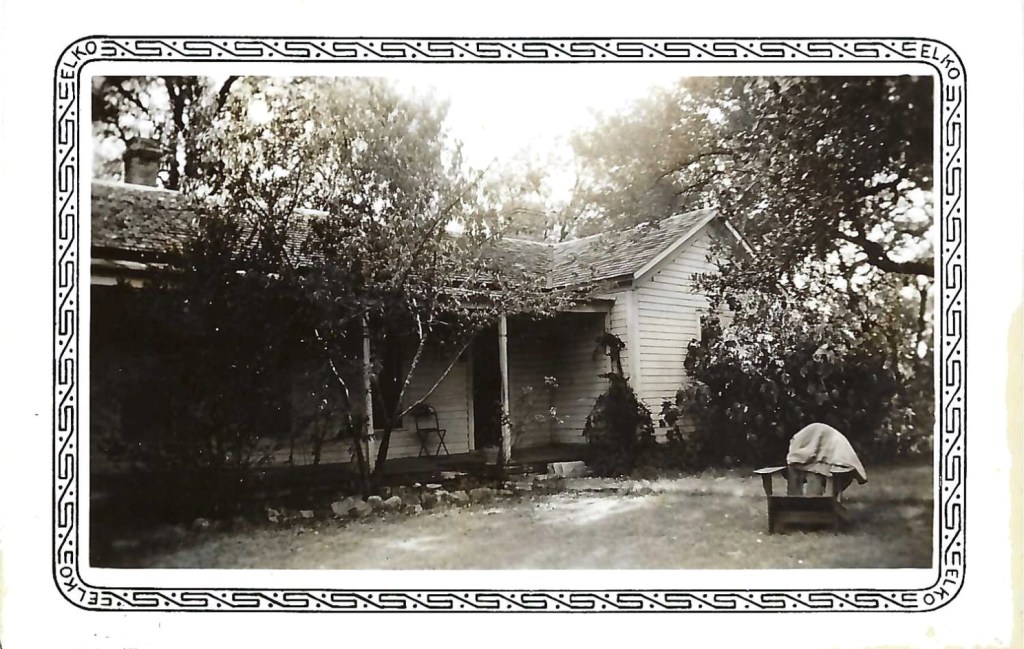
Years ago, when we first moved to Georgetown, my Aunt Sha would comment that now that we had a house we should go get the curb stones from the old Howard place. I sort of knew what she was talking about. Thomas and Helen Melvina (Pickens) Howard came to Texas in the early 1870s and they bought what has come to be known as The Old Home Place. I still have lots of work to do on the origins of the family, as they have been elusive to this point, but once they reached this spot, they settled down and stayed for three generations and, as I recall, the 4th generation still owned it. The curbstones had lined the walkway and flower beds around the house. They had been carved by my great-great-grandfather Thomas Howard, who was a stonemason and is said to have worked on the foundations of the Texas State Capitol building. I wonder if there are any records of that anywhere?
The Howard Adams Place, circa 1942.
Their original homestead was on the current Railroad Street here in Georgetown, across from The Caring Place, on the grounds of an apartment complex. The site of the original house and outbuildings has been left as green space on the corner of Railroad and 19th.
Site of the Old Howard Adams Place, taken from 19th street looking south. I think that’s the old cistern there in the foreground.
I think my aunt had finally sold the property in the early 2000s and we had kind of forgotten about the curb stones. But then one day my oft-mentioned Aunt Billye called and said she had stopped at the construction site of those apartments and had explained who she was and asked if it would be alright if we came and got some of the stones. We weren’t sure how we’d manage it, just her and Sean and I, but we rented a flatbed truck from Home Depot and drove over there. We were walking around that corner where the old house had been and Billye was pointing out the locations of things as she remembered them and we were trying to find the stones and figure out how to extract them, when a guy who had been working on another area of the property came rumbling over in a Bobcat. We explained who we were and what we were trying to do and he was really interested to find out more about the old homestead. Apparently, as they had been cleaning stuff up in that area, they had found all these intriguing things, like the old well or cistern, old chicken wire and barbed wire fencing, and the old curb stones. So we had a nice visit with him reminiscing about the old homestead and then he got in his Bobcat and started lifting up stones for us! He was one of those guys that can use a Bobcat like a precision instrument and he carefully scraped dirt off of some of them and dug under others and lifted them out of the ground so we could pick them up and get them to the truck.
They are not small things. The smallest curb stones are about 12 x 6 x 6 inches and the largest complete stone we were able to find is about 36 x 6 x 12 inches . We also found partial stones that are in between those sizes. And they are HEAVY. They must be limestone and I assume they must have come from one of the local quarries, but they are dense. I’ve hauled around limestone rocks before for gardening projects and they weren’t anything like these. Our helpful friend carried the big one over to our truck on the Bobcat because none of us could carry it that far.
And the really cool thing is you can still see the tool marks. These aren’t fancy dressed stones. They are almost utilitarian. I don’t know if Thomas worked professionally as a stonemason, other than the time he is said to have worked on the capitol. All other sources have him as a farmer. I guess I’ll have to do some more digging into his professional life, huh?
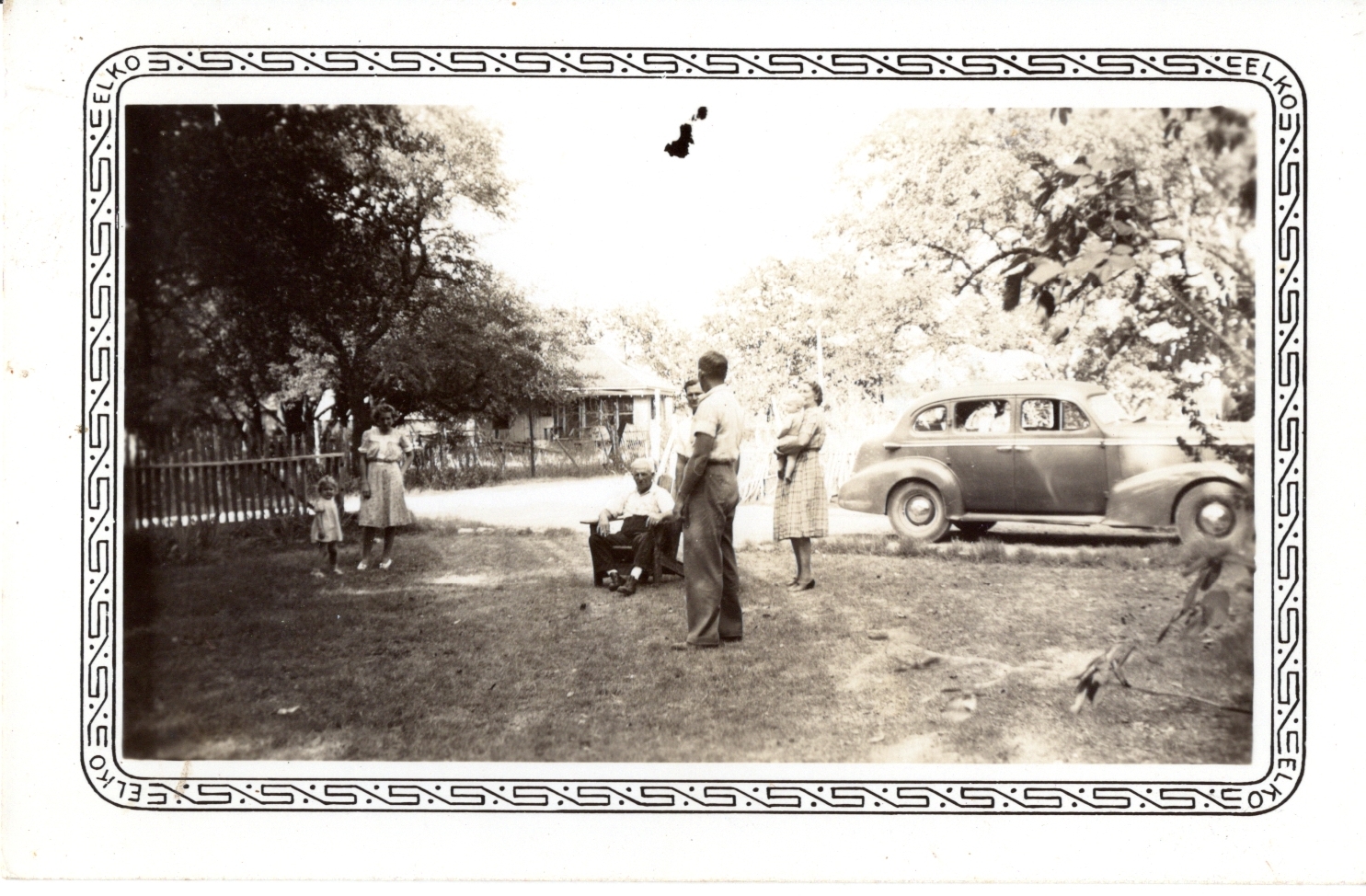
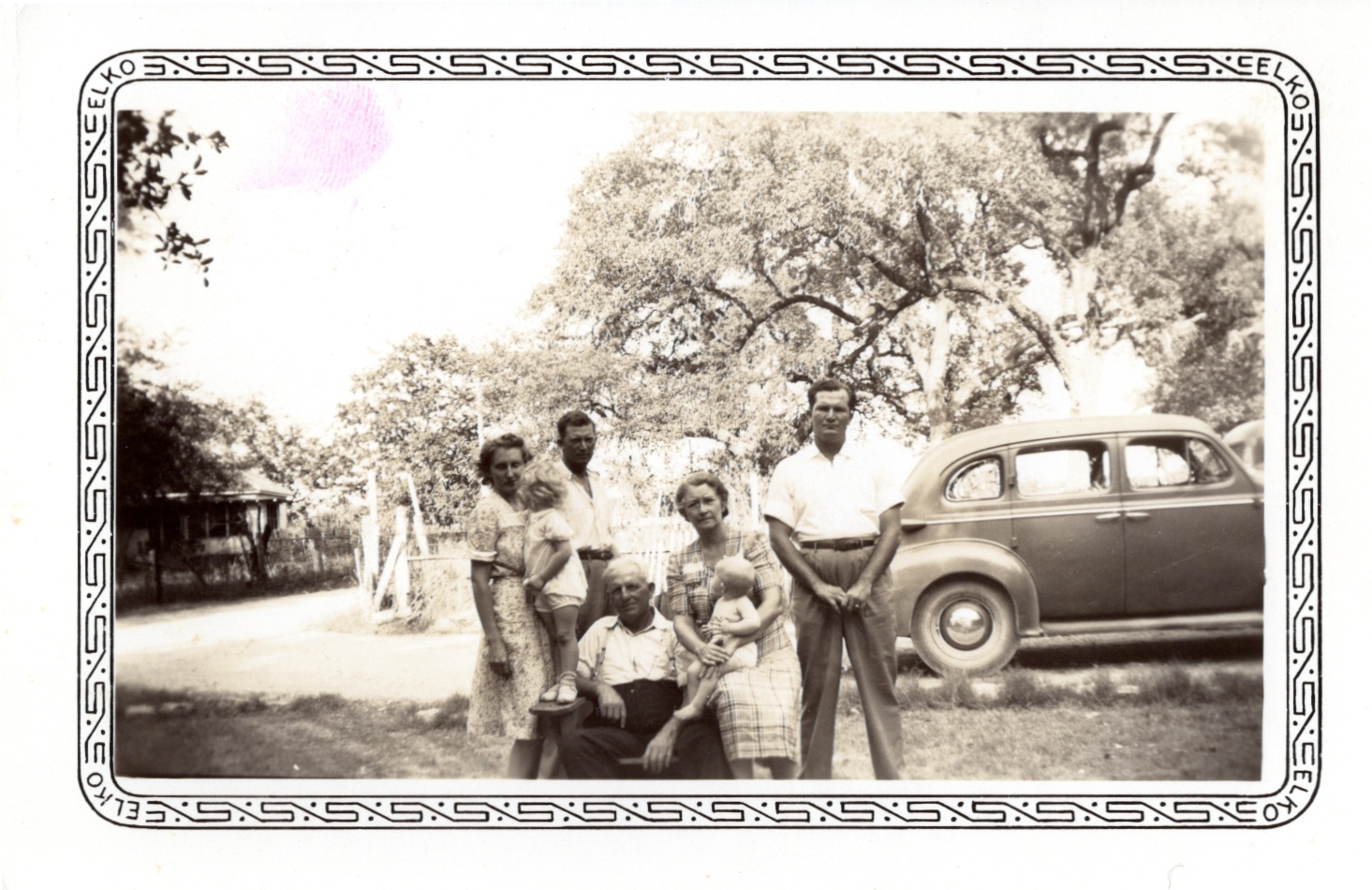
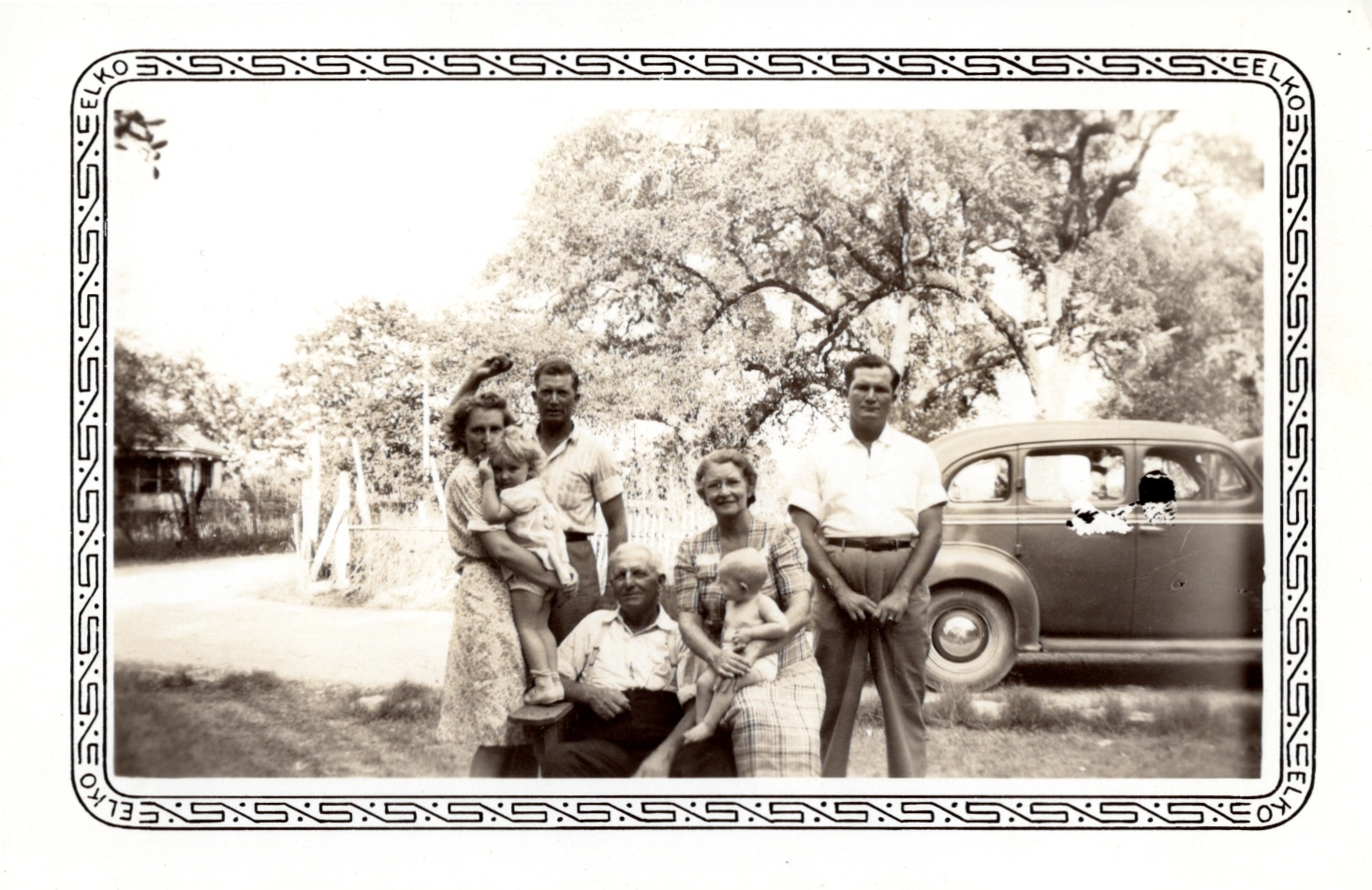
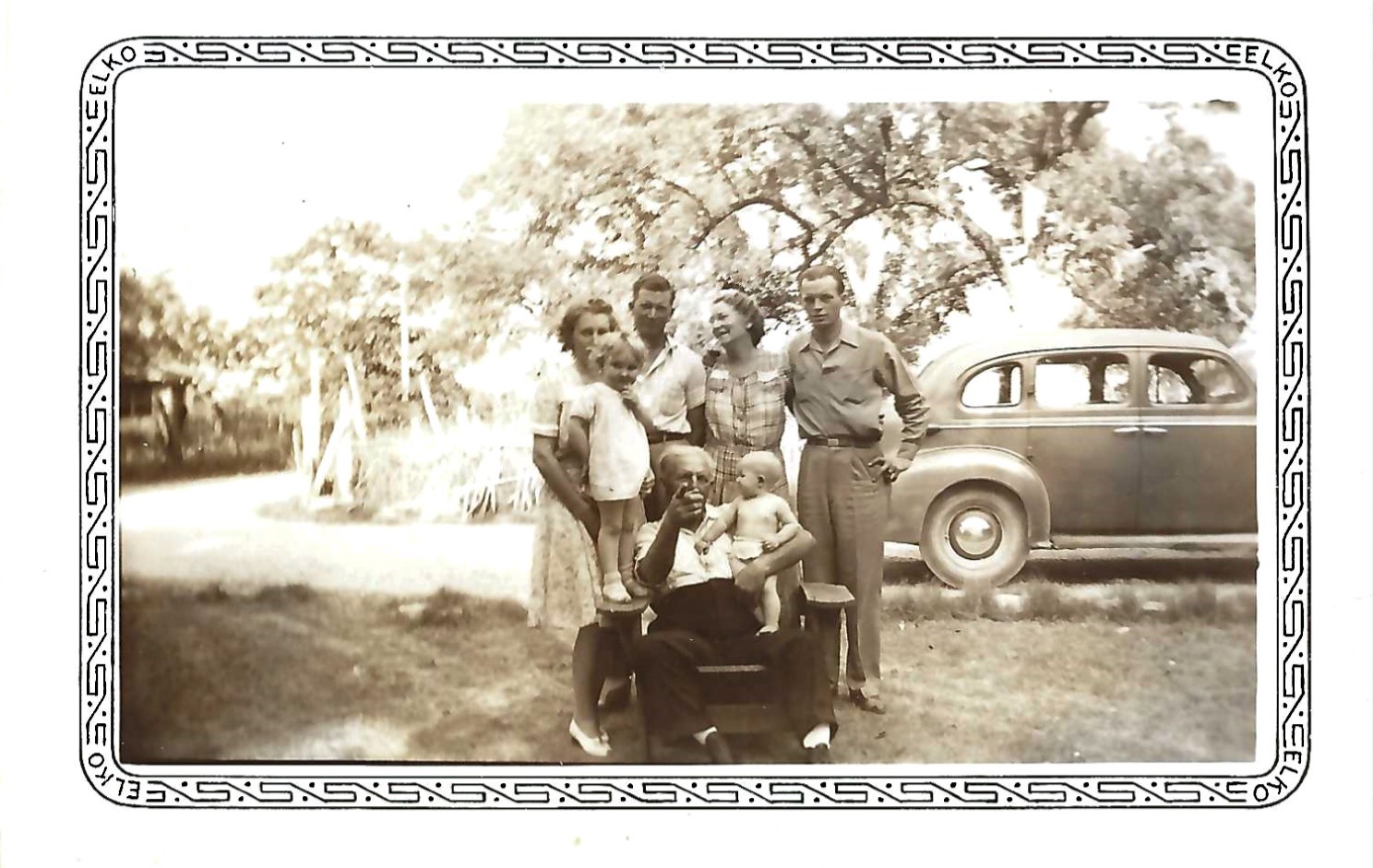
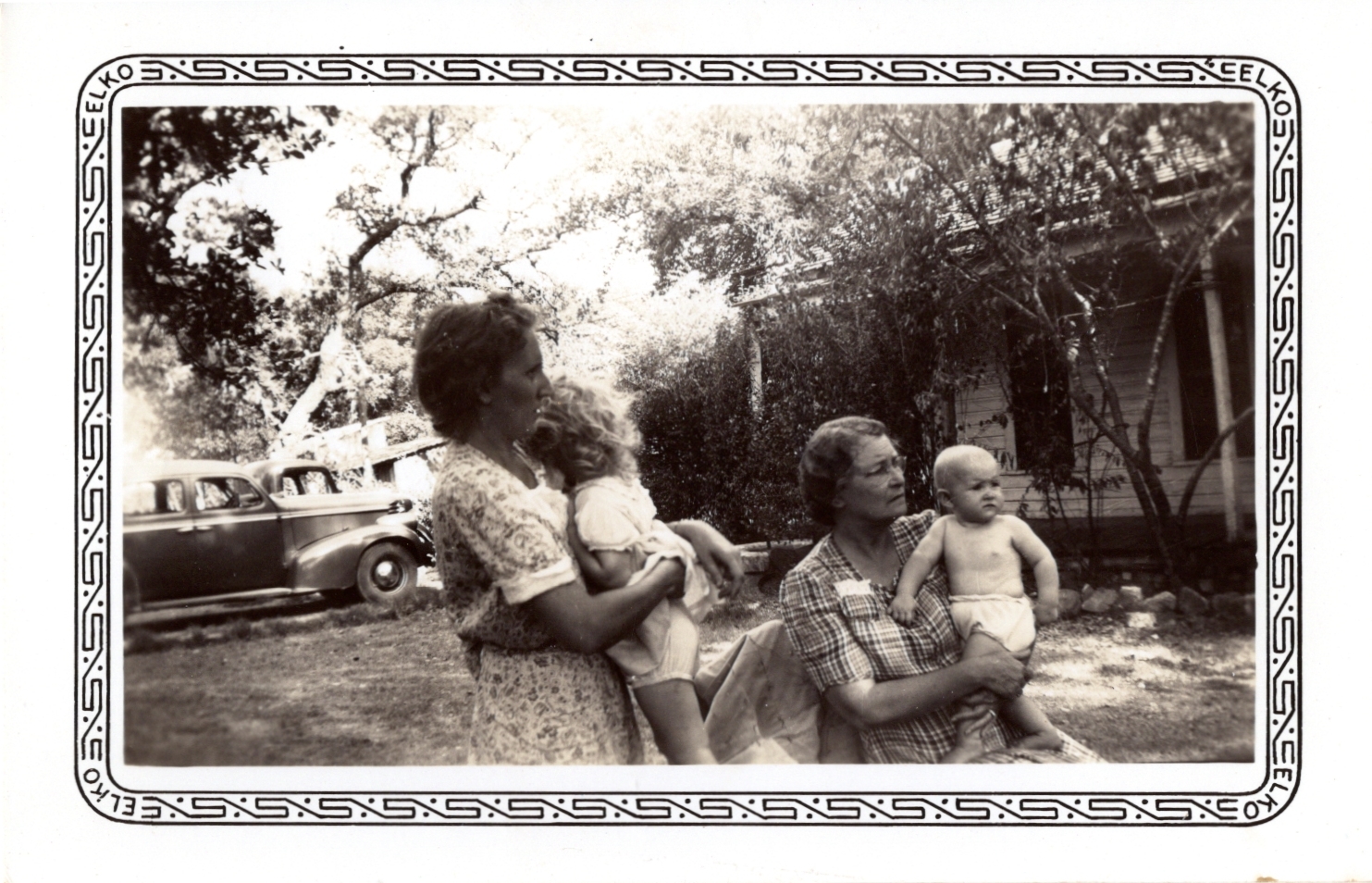
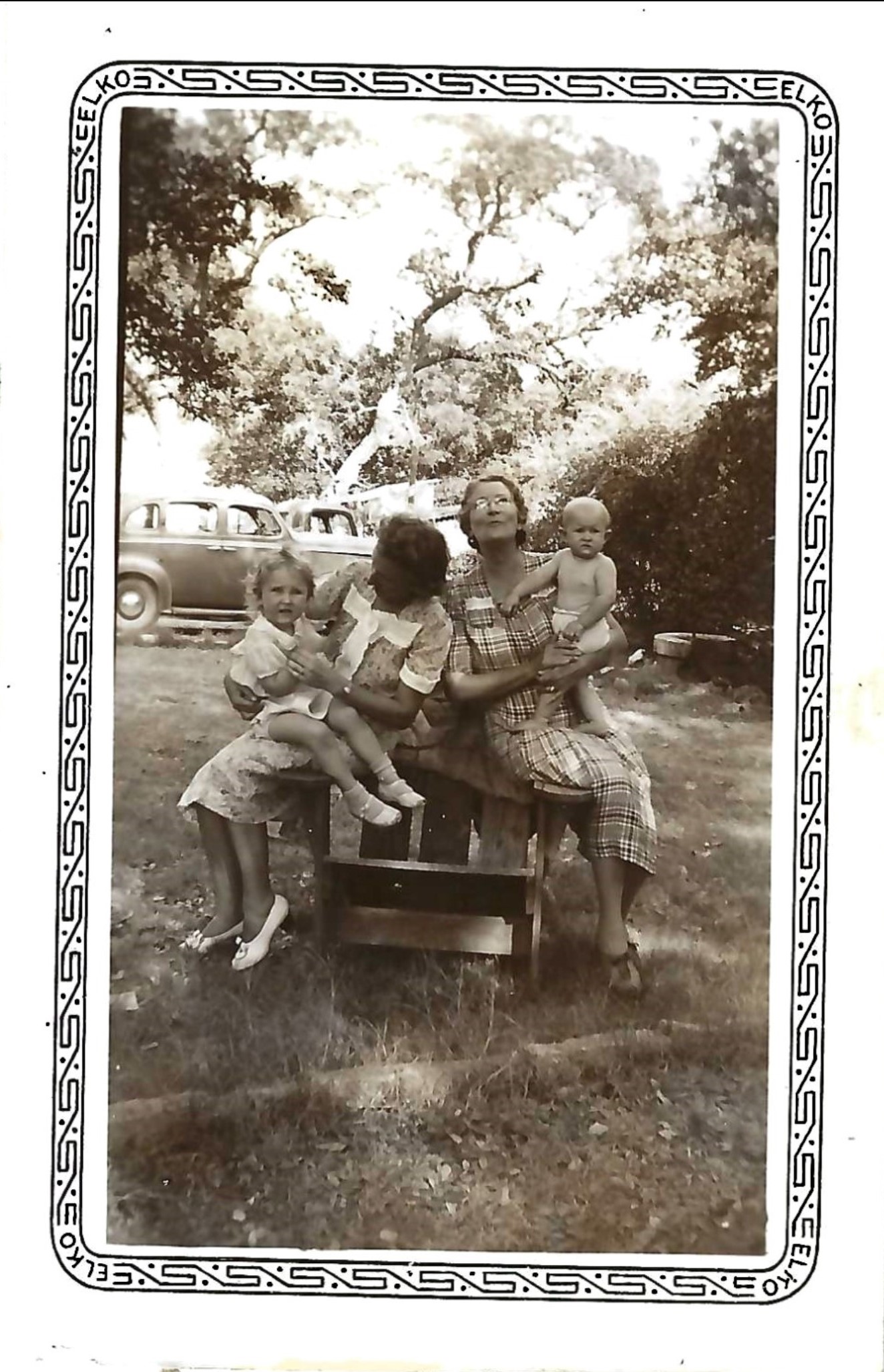
This series of photos is from the Old Home Place, around 1942, judging from how old Aunt Billye is. She’s the tiny one in diapers. And the toddler is my mama, Kay. The older couple are my great grandparents, Jack and Mary (Howard) Adams, The younger couple are Jack Howard and Tut (Edwina Sandberg) Adams, parents of Kay and Billye. The two other men are Jack and Mary’s sons Elzah (in the white shirt) and Earl (in the long sleeve shirt) Adams. I love this series of pics, starting with the random group shot of everyone not yet organized. I can’t imagine trying to wrangle this group. Maybe this was Easter? It was early in the war anyway, before the three boys got sent off in various directions. You can see the curb stones in many of the shots, particularly the ones of Tut and Mary and the little girls, but also lining the driveway behind them and along the flower beds.
So that’s the story of those gray stones around the front flower bed at our house. If anything happens to Sean and I, I hope some Howard descendant will come get them before they have to sell off our house!
P.S. Also, I got the WORST case of poison ivy from picking up those stones. Didn’t even think about it at the time and I’m sure all the obvious poison ivy had been mowed down by that time, but the roots were still in the ground and when we disturbed them the poison-y stuff got all over the stones and subsequently all over me. Luckily I was wearing gloves, but it still got all over my arms and across my belly because of the way I was carrying them. I think I eventually had to get a cortisone shot. Yikes. Worth it though!
P.P.S. I’m experimenting with slideshows, so don’t miss the series of pictures in the two at the end of the post! You can click the little arrows on either side of the photos to advance.
So I thought I wouldn’t have any trouble with this week’s topic. I have a plethora of immigration records for the branches of the family that I can trace. But when I settled on our first Swedish ancestors as my topic it sent me all the way back to the early days of my research and I got caught in a procrastination whirlpool. I was looking at the immigration record for my 3rd great grandparents, Jonas Christersson and Maja Lena Svensdotter and their four children, and in trying to refresh my memory, as well as retrace my steps of probably 15 years ago now, I got stuck on the question of how I knew where to look for them in Sweden.
As I recall, my Aunt Billye was the one who found that ship record (above) showing the family arriving on the Ship Lexington, in Boston, Massachusetts, on September 20, 1853. When I got my Ancestry account in October of 2010, I started compiling all of the information I could about them from what was available, but it was mostly just census records at that point. But sometime that fall Ancestry released the Swedish Church Records. It may have been the reason I started my subscription, but I kinda remember sitting down at my laptop one morning and opening an email annoucement and getting super excited. Prior to that, if you wanted to search those records you had to purchase a DVD set for a princely sum and then you had to know how to find what you were looking for. The records on Ancestry weren’t very user friendly either, and it took me some weeks, with the help of a book that Aunt Billye loaned me, to figure out how to trace our family in those records. But by the next June I had a very detailed story to present at our family reunion. I had found both Maja Lena and Jonas’ families in Sweden, gone back more than a few generations, and traced a few of their siblings, adding some cousins to our family tree who we had always only known as family friends, and realizing that some branches we had thought had only married in were actually fairly close cousins.
But I still can’t remember how I knew where to look! Swedish Church Records are very detailed and if you know the name of the parish a person came from and either the year of their emigration or their birthdate you can find them in the parish Birth Records or what’s called the Moving Out Records and start tracing them through the Household Examination Books. I’ve spent the last week going through all of my primary sources that I would have had available at that time looking for any reference to the fact that Maja Lena was born in Lekeryd, that Jonas and all four of the kids were born in Forserum, or that the family emigrated from Forserum. And I can’t find anything! I also can’t find my research notebooks from those early days. They are somewhere in this house, but — detour! I was sitting here typing and something made me look to my left and there they were! Well, not quite that simple, but I had consolidated some of my genealogy stuff and I didn’t remember where I’d put it till I was sitting at just the right angle to see that shelf. Ah the trials and tribulations of the disorganized. Anyway, it didn’t really help, because even though I found the notebook I’d been wanting, it didn’t shed any light on the question of how I knew where they emigrated from. Sigh.
The good news out of this week of searching is that I’ve been looking through all kinds of boxes and notebooks and files and I happened across some things that I’d always meant to scan. So I’ll share them here instead of hiding them in a to do pile!
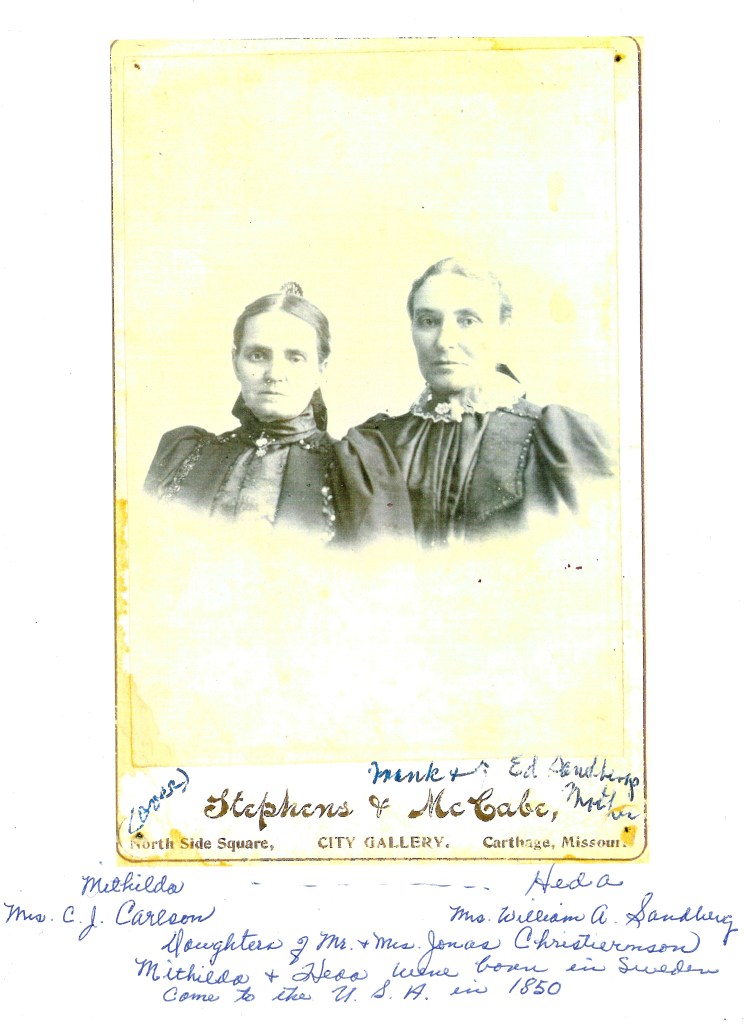
Anna Lena Jonassdotter Christerson Carlson & Hedda Christina Jonassdotter Christerson Mercer Sandberg
I had completely forgotten about this photo. I’m not entirely sure where it came from and the handwritting is sort of familiar, but I’m not sure whose it is. It is a color copy of a scan of the original and it comes from a collection of old scrapbook pages with lots of other photos that I have seen before and mostly already have in my collection. The note at the bottom says this is a picture of, on the right, our Hedda, my great-great-grandmother. As noted, she was mother to Frank and Ed Sandberg, as well as Hilda and Mart.
The notation for the woman on the left, though, is a little garbled. Hedda had three sisters, Anna Lena, Mathilda, and Adla Suzanna. She also had a brother Sven August. The four older children are listed in the ship record above. Adla Suzanna was born 21 June 1859, after they had been in America for about 5 years. And Maya Lena was 47 when she was born! The notation says that this is Mithilda (spelled wrong all three times) and that she is Mrs C. J. Carlson. I am pretty certain that this is not Mathilda, because she died in 1870 at the age of 18, when Hedda would have been about 25. Neither of these women are that young.
The name Mrs. C. J. Carlson is incorrect, and comes from the description of the family from page 181 of The Swedes in Texas, 1838-1918. Hedda’s oldest sister, Anna Lena, married a guy named John Carlson. I started to tell their story way back in 2018 when I started this blog (link here. I probably ought to get back to that…). So the surname is correct, but the initials are not. But the thing that tells me that this is Anna Lena is the address of the photographer, on the square in Carthage, Missouri. When John left Texas after “the incident” he and the rest of the family ended up in Carthage, Missouri.
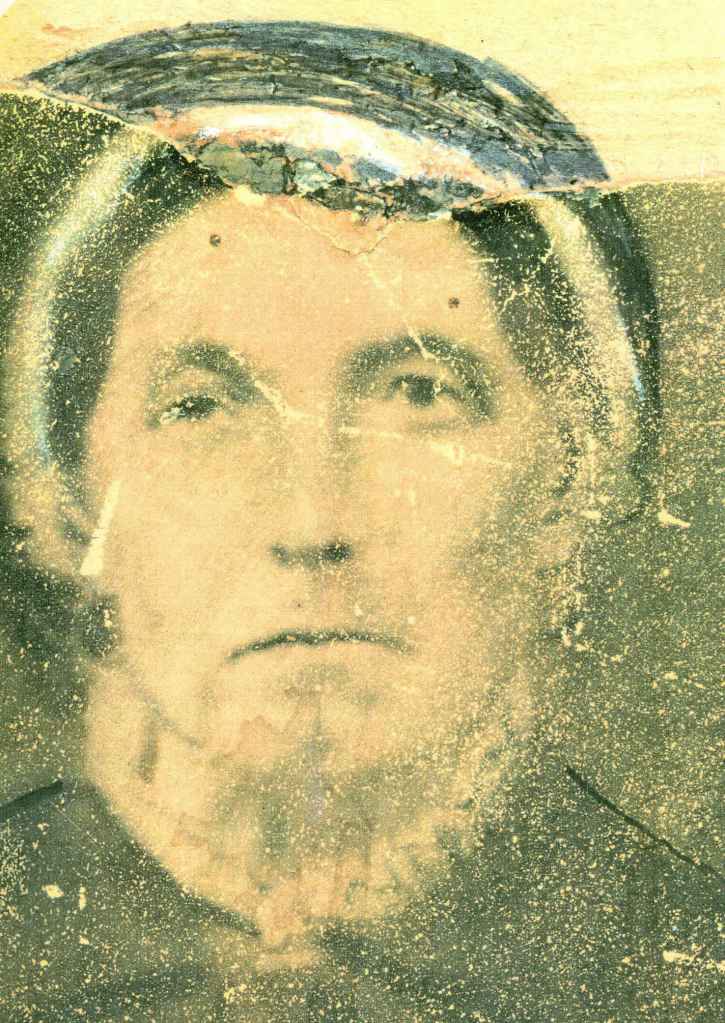
Maja Lena Svensdotter Christerson
Also, she absolutely has her mother’s eyes.
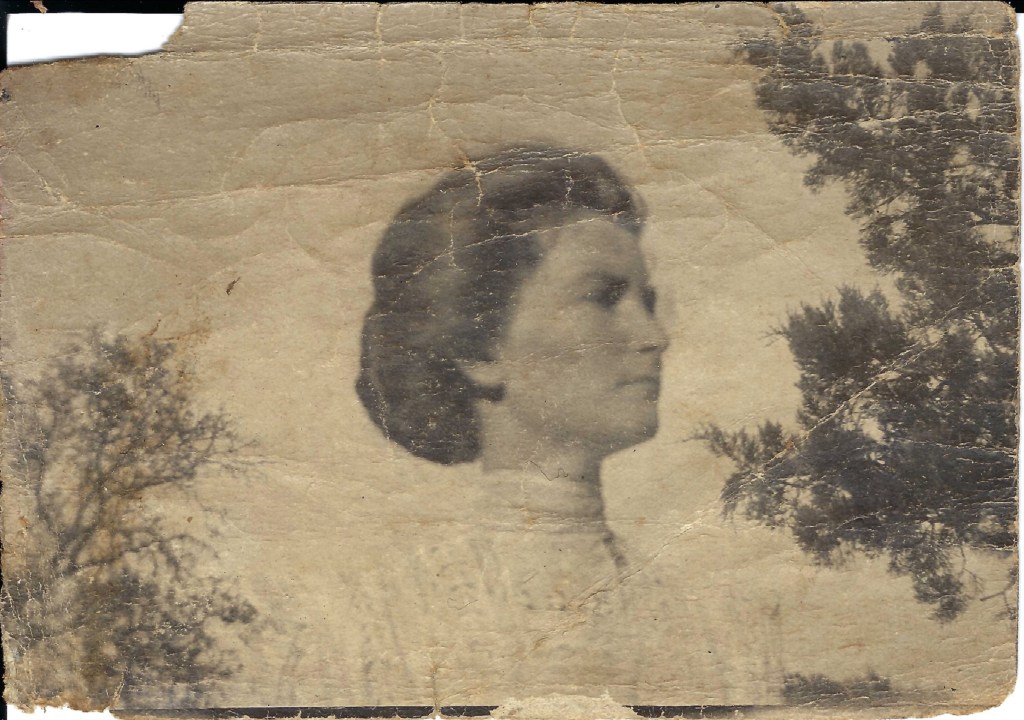
I also found this lovely photo of my great grandmother Mary Belle Howard Adams as a young woman, probably around 1900.
Mary Belle Howard Adams
Paula Jacqueline Sanders & Jack Howard Adams
This cutie-patootie picture of my little sister, Paula, with our Popo Jack, circa 1972.
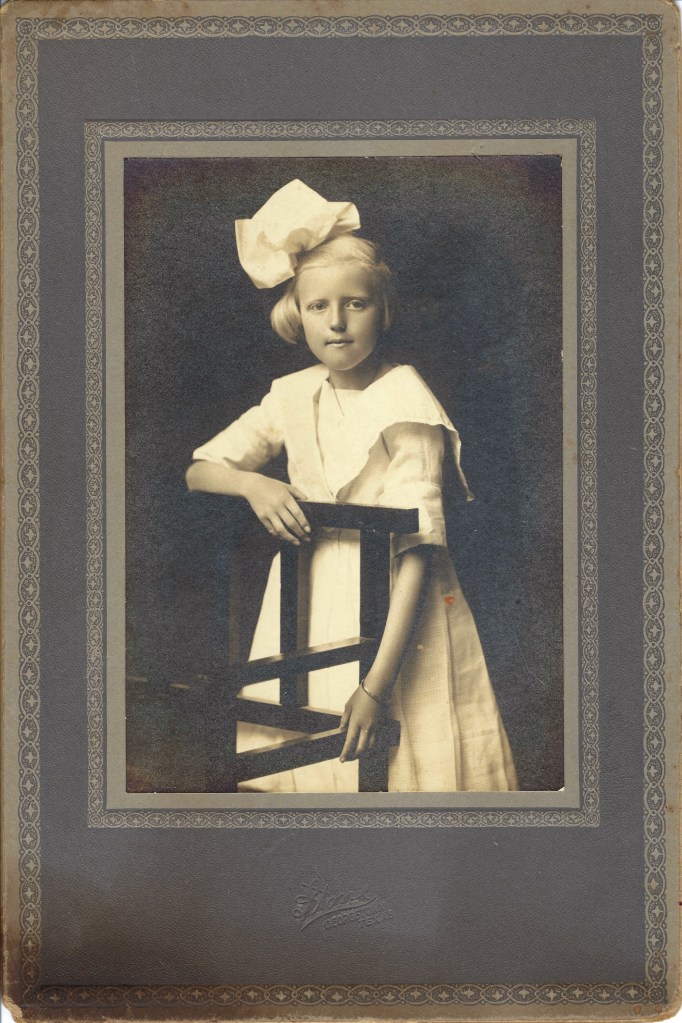
And this wonderful portrait of my great Aunt Flossie. I imagine this must have been right around the time that she and her father and her sister Lillian moved to Texas in 1908.
Florence Anderson
There are lots more where these came from, so I’ll have to plan some scanning time into my weekly schedule and get some more of these shared on here. And hopefully I’ll get myself back on track for next week’s topic, “Heirlooms.” I guess photos count as heirlooms? Don’t they? You might just get more of these!
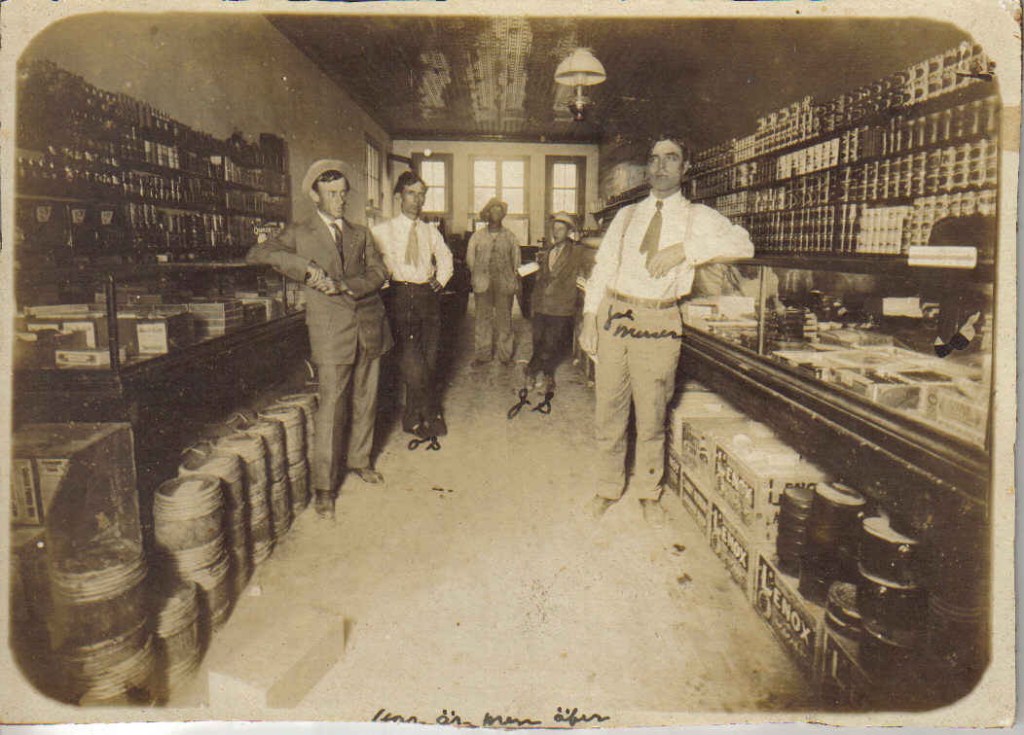
I am really lucky to be blessed with a treasure trove of images that bring the lives of my ancestors to life. The picture above, from around 1909, is of Unknown Guy, Per Oscar Sand, alternately called called P.O. and Oscar, Another Unknown Guy, John “Slim” Sand, and Joe Mercer, in their store on the square in Georgetown, Texas.
Per Oscar Sand is my great-great uncle in-law, father to Irene Irma Sand Lundblad, John “Slim” Sand, and Margaret “Mug” Sand Swenson. He was married to my great-great-aunt Hilda Sandberg on February 11, 1896 (married by her half-brother-in-law August Wallin, a Methodist minister). Their first child, John, afterwards known as Slim, was born May 28, 1896, so, …um, …, their second child, Irene, was born in 1898, their third child, Mug, born in 1900. Hilda died in 1902, and we can assume that with that timeline, she perhaps died in childbirth.
Joe Mercer is the son of Joseph A. Mercer, who I talked about in my post on January 25th, and my great-great-grandmother Hedda Christerson. So that would make P.O. and Joe brothers-in-law. They also became widowers in the same year. Joe and his first wife, Anna Larson, had five children, Paul (1891), Frank (1893), Alma (1895), Joseph (1898), and Mildred (1900), so we can suppose that she also died in childbirth.
I found a number of references in the Texas Posten (this links to a description of the newspaper, which is a great resource, with a little help from Google Translate, for the Swedish Texan community in the early 20th Century.) about Joe working in various retail establishments in Taylor and Georgetown, Texas, including grocers and hardware stores. He always advertises his connection to the Swedish community and the fact that he can speak Swedish. In the fall of 1909, there is a notice in the Texas Posten about Joe and P.O. opening a store together.
“— Messrs. Oscar Sand and Joe Mercer sell groceries as cheap as any in town. When you are offered very cheap prices on groceries, come to us in Fosberg & Anderson’s old location and you will get the same old cheap prices.”
Texas Posten, October 7, 1909, p. 7.
But then there don’t seem to be anymore mentions of the two of them working together. In the fall of 1910, Oscar has teamed up with another fella and they have bought out someone else’s grocery stock and are moving premises
“We have bought Heard & Anderson’s grocery store on the southwest corner of the square, and have moved our warehouse from our old location in the Glascock building to Heard & Anderson’s location, making two stores in one. We want your business and will treat you right. If you pay in cash or if you want to buy on credit, come to us. All kinds of Swedish goods always in stock. Respectful, Oscar Sand, Ben Behrens”
Texas Posten, December 22, 1910, p. 13.
And then, in 1911, Joe went out on his own.
“— Note.—I have bought out the stock of the grocery firm of R. H. Chritzberg, Glasscock building across the street from the post office. I intend to continue the business in the same place and shall gratefully value the trade of my compatriots. Sincerely, Joe Mercer, Phone 343, Georgetown, Texas.”
Texas Posten, August 3, 1911, p. 5
Note to self here: I did some research to see where this Glasscock building might have been, and I think it is in the row of buildings on the north side of 7th Street, just east of the Square. The post office on 8th Street wasn’t built until the 1930s. In the early 1900s the post office was housed in the Masonic Lodge building, the one with the onion dome, on the corner of Main and 7th.
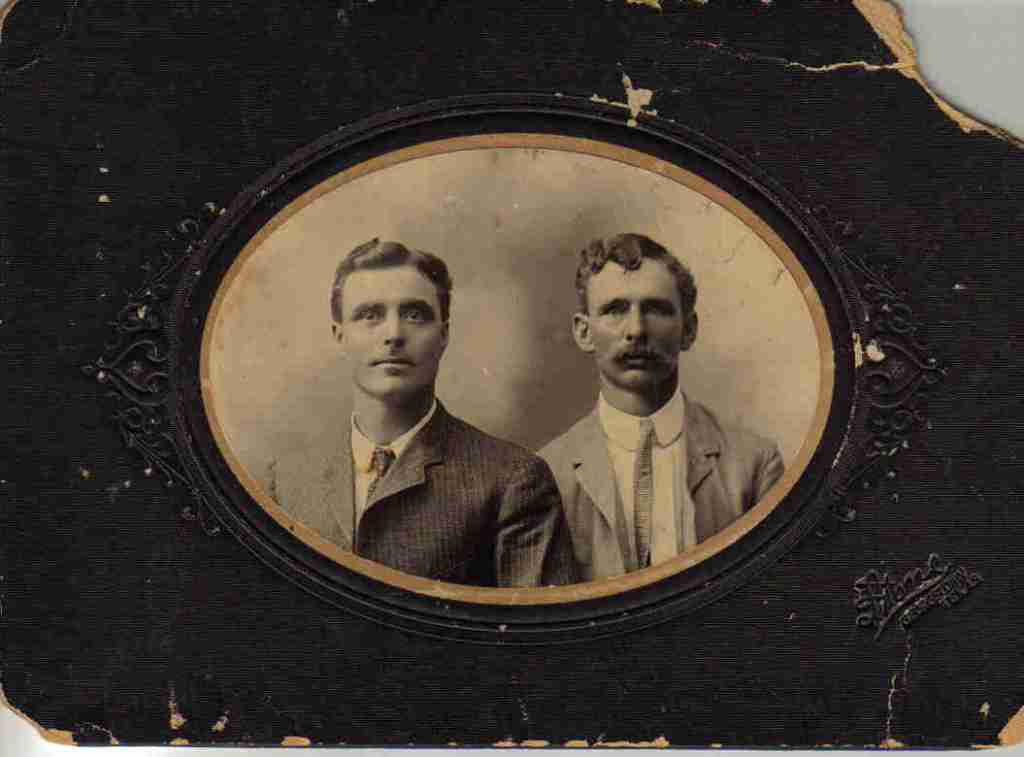
Joseph A. Mercer, Jr and Per Oscar Sand, taken around 1909
I just really love this picture. The two of them look so self assured. And I adore their hair! Especially Oscar’s! In this and other pictures you can always spot him by that curl in the front, the mustache and those ears. And you can always tell it’s Joe by those eyebrows!
I’m so curious as to why their partnership fell apart and what happened in those few years. Before and after this time, Joe, particularly, continues to be employed as a clerk in other people’s businesses. He also appears in census records noting his occupation as a store clerk in groceries. I so appreciate having this visual proof of what he did to earn a living. Thanks, Aunt Diddie, for saving these and others from the burn pile (but that’s a whole nother post!).
I’m so late with my post this week! I really struggled with this one. So MANY possibilities! And the more I tried to narrow it down the broader it got. In my genealogy journey I have been many times blessed to have access to a wealth of family information, whether in direct access to, and plenty of time to spend with, relatives who were the keepers of the heirlooms/photos/farm/stories, or the treasures of family bible pages, scrapbooks, detailed family trees, and wonderful writers who wrote the story down for future generations. And to be honest, I already have posts about those folks planned for future weeks. And then it struck me. The Blue Book.
Most people properly call it Swedes in Texas in Words and Pictures 1838-1918. In my head I call it The Blue Book. In my research notes I usually abbreviate it as “SIT”. It was originally published in Swedish around 1918, in two volumes (with red covers), as SVENSKARNE I TEXAS I ORD ACH BILD 1838-1918, and subsequently translated into English and republished in 1994. It is a lovely, blue chunk of a book, weighing in at about five pounds, about eight by eleven inches, three inches thick, and 1208 pages long, not including the indexes. It took an army of folks and around 5 years to translate it and I can only imagine what a daunting project that was. And I am eternally grateful to those folks for all their hard work (including cousin Mabel Lindell, who is mentioned in the Dedication at the beginning of the book). Sitting cross-legged in my big arm chair with this tome in my lap, and the Swedish Church Records on Ancestry.com open on my laptop, I was able to trace my grandmother’s family back to the villages and farms in southern Sweden from which they made the trek to Texas. I remember sitting around the big dining room table at “The Farm,” trying to get my Anderson ancestors straight in my head, making my Mama Tut and Aunt Diddie laugh till they cried because I kept pronouncing Knut with a Swedish chef accent and a really hard “K.” And I love just sitting with this book, flipping through the pages, visiting the stories and familiar faces of my folks and discovering the stories of other families who took a chance on Texas.
I did my DNA on 23andme many years ago. Through a connection in the online Crohn’s and Colitis community, I received an offer to contribute my DNA, through 23andme, to a genetic study of Crohn’s, colitis, and inflammatory bowel disease. In exchange for contributing, I received my health and ancestry data. An easy sell for this budding genealogist at the time.
It has provided some interesting insights and connections. The genetics hold up with what I have confirmed with my genealogy research. And it’s nice to know, though I never doubted, that my parents are my parents and my sister is my sister. Otherwise, mostly you match with 4th or 5th cousins who don’t provide any family tree information that might help one figure out what your connection is. It’s not often that I get a close cousin match that I don’t know, but back in 2016, I got two! I matched with a father and son who were 2nd and 3rd cousins on my mother’s side and had a surname that made me a little breathless.
See for many years I have had a minor genealogy crush on my 2nd step-great-grandfather, Joseph A. Mercer (1843-1872). You know the kind. You have a few bits of information and maybe a single picture and you just get so intrigued you can’t stop searching for more!
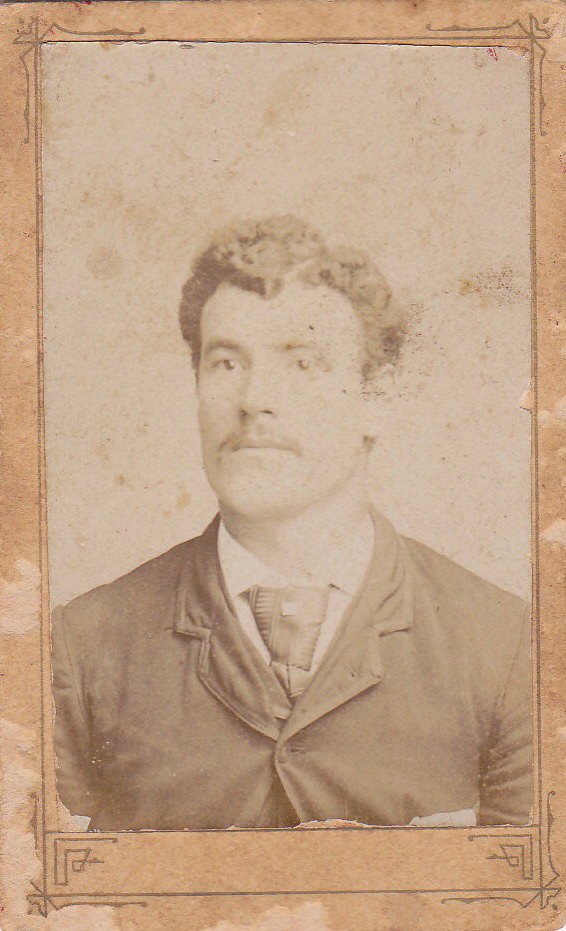
Who was this guy? And what had prompted my 2nd great-grandmother Hedda (Hedda Christerson Mercer Sandberg, 1844-1916) to marry this random, stray Yankee P.O.W. that a family friend had brought home at the end of the Civil War? I mean, I know, he’s handsome. Just look at those curls! But it was highly unusual in her tightly knit Swedish community for a young woman to marry someone who wasn’t Swedish.
Anyway, he became a bit of an obsession. For starters, my grandmother’s generation knew we were related somehow to these Mercer folks, but not so much how. And there was some confusion about Hedda’s marriages and the children from the first marriage. I eventually sorted it out and, this being back in my baby genealogist stage, some of the searches were among my early triumphs over badly transcribed census records (try searching on just the first name in the location where you think they lived and try not to wake up your husband when you holler “I found them! I found them! at 2 o’clock in the morning), as well as my feelings of anxiety over submitting records requests to complete strangers at big intimidating places like the National Archives (I’ve mostly gotten over that).
And he’s still a brick wall! but I digress from my original topic: cousin matches…
So I emailed with these two gentlemen and it turned out that we share Hedda as a great- and/or great-great-grandmother. The son shared some family history and we confirmed the connection. He also shared some info about his dad, just casually mentioning that his dad, Bill Mercer, has his own Wikipedia page. Okay. So I go look…
He was one of the original sportscasters for the Dallas Cowboys!?! He called The Ice Bowl!?! The Texas Rangers!?! Professional Wrestling!?! The JFK assassination!?! He’s written twobooks! And he’s being portrayed by an almost as cute as him actor in the new movie, The Iron Claw! Plus he’s just really nice. And boy, did he witness some history (Click that link on his name above) Wow!
Dang. Now I’ve got another crush.
I mean, look at this guy! What a smile! We got to meet and visit with him when he was broadcasting a Round Rock Express game.
Here he is in action! Just above the “R” in Horn, in the booth with Mike Capps.
He also came to Georgetown another time with his daughter to visit all the cousins at Cousins Day (note to self: do a post about Cousins Day…), but I can’t seem to find those photos (note to self: organize photos…)
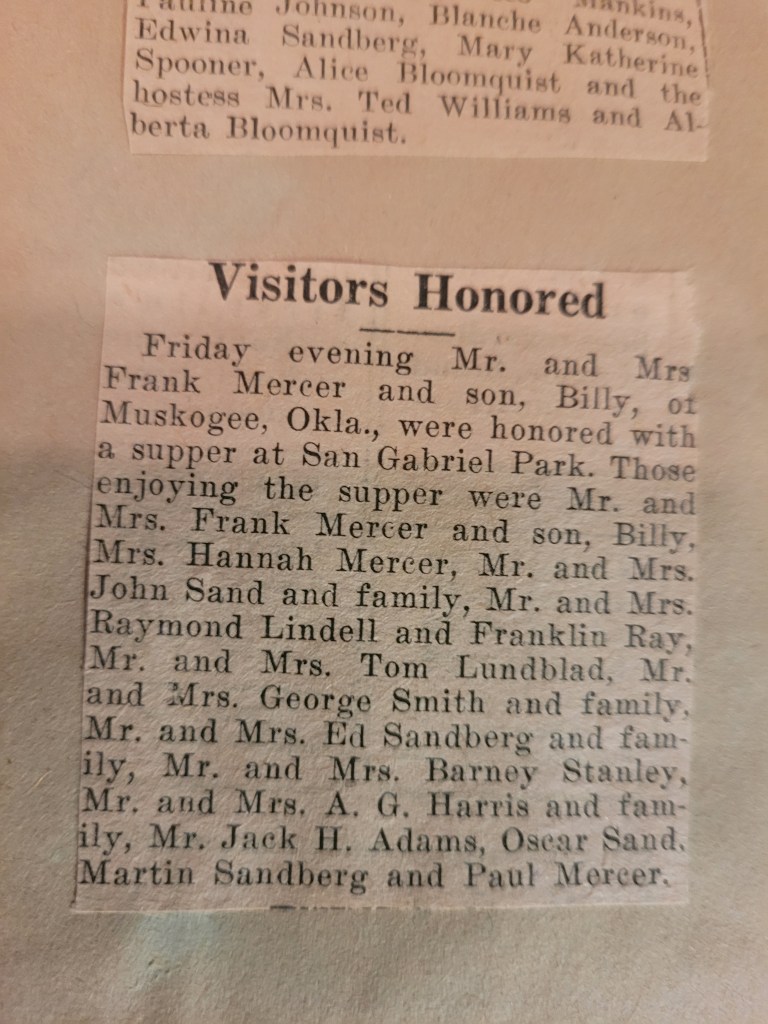
Just one final tidbit: This week I was going through an old scrapbook of my grandmother’s (Edwina “Tut” Sandberg Adams) and came across this clipping.
The scrapbook is from the 1930s, ending in 1938, just before my grandparents get married (my grandpa is “Mr. Jack H. Adams” and my grandma is included in “Mr. and Mrs. Ed Sandberg and family”). “Mr. and Mrs. Frank Mercer and son Billy” are Bill and his parents. All the others are Sandberg and Mercer kin of various generations. It’s always fun to see these little mentions in the local newspaper.
How to even begin to choose a favorite photo! I am very lucky to have had ancestors who kept scrapbooks and photo albums and even random drawers or tins full of snapshots. Most but not all are identified on the back, and I was lucky to live near enough to some of the elders who could tell me who folks were in some of the unlabeled pics.
Thanks to my genealogy hero, my great Aunt Diddie (Ruth Marie Sandberg Carlson, 1919-2013), we even have pictures of my 3rd great grandparents, Jonas and Maja Lena Christerson!
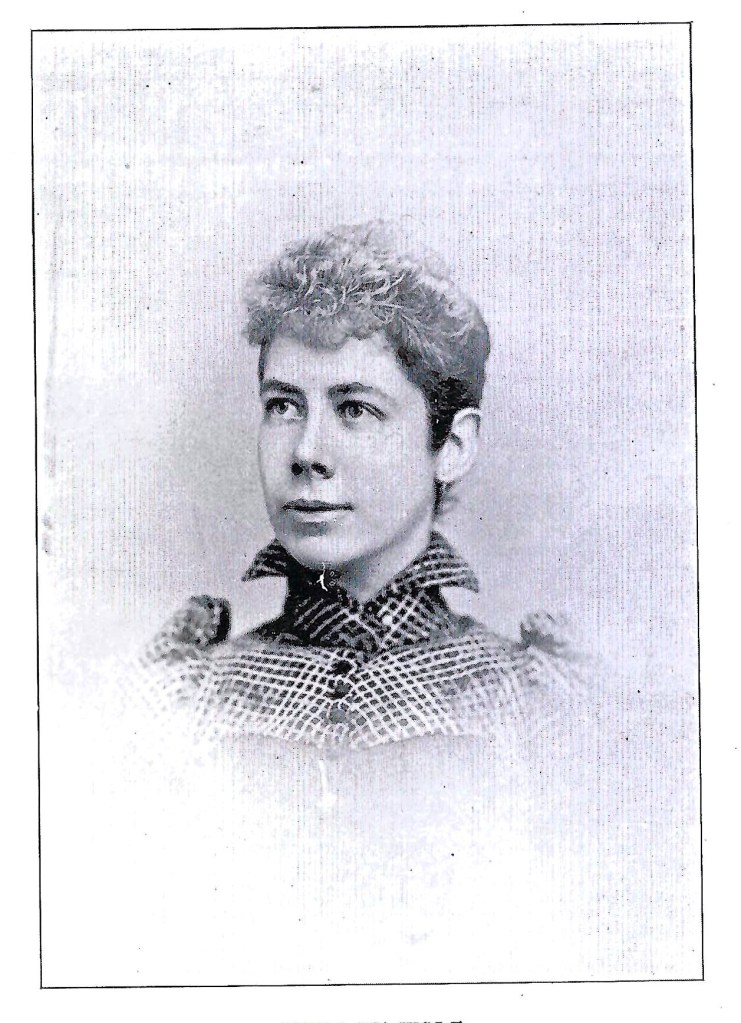
So for the purposes of this exercise, I will be featuring The Photo I Was Most Delighted To Find. I give you, Miss Izora De Wolf!
Izora is another genealogy hero of mine from my paternal side. She is my first cousin 4x removed, and the youngest of 8 daughters of my 3rd great grandaunt Catherine Harrington De Wolf and her husband William Bills De Wolf. She was born in 1853 in Conneaut Township, Erie County, Pennsylvania, but I first encountered her in the Local History collection of the Harris Elmore Public Library in Elmore, Ohio, almost 10 years ago now. There was a tantalizing mention of my 4th great grandfather (Izora’s grandfather) Mathews Harrington in the list of the collections holdings. It was just his name in this long list of items, no other details or any idea of what it might be. So the Harris Elmore Library was one of the must-see stops on our Ohio Genealogy, Quilting, and Baseball Tour of 2016. What we discovered was about 20 xeroxed, typed pages in a thin, blue report cover with a simple label on the cover that read “Mathews Harrington,” which, when opened, revealed the following lines:
REFUGITIVE FAMILY REMINISCENES
Written by Izora DeWolf, May 1913
My feet are on the western slope. It is pleasant here facing the sunset; and I walk the gently descending path cheerfully, gathering many a bright autumn flower by the wayside. But I cannot bear that those who walked before me and beside me in the morning light should disappear in the twilight shadows and pass utterly and forever from the sight of those, equally, though differently dear, who follow, and those who will follow, in our footsteps. I flinch from the thought that to the babies now in our family cradles, and the dear dream babies who shall yet lie in them, these, who were rocked in my cradle and fed at my mother’s breast, should be — just empty names, as mythical as Mercury or Diana. So I tell these simple intimate stories so simple, some of them, that, at first hearing, I fear they may seem silly to the more literal-minded of those for whom I tell them, but listening closer, I trust that some descriptive note may be found in most of them. For some I cannot make even this claim to a hearing. I just tell them because they were told to me at a age [sic] when every tale was a fairy tale and when life itself was the biggest fairy tale of all. And I somehow hate to have them laid aside and forgotten. I wonder if this fumbling explanation explains.
In those few words she had so elegantly encapsulated all the reasons why I do genealogy (and also the reason I finally determined to take on this 52 Ancestors 52 Weeks challenge!). Because even if what followed in those typed pages was far too brief, it gave flavor and life to the myriad official documents I had been able to attach to these ancestors. I knew Mathews had arrived in western Pennsylvania in about 1800, but what a treasure to have his granddaughter relate the story she had heard from him about how he walked from his home in Vermont across the frontier to “the vicinity of Cherry Hill.” And to hear my 4th great grandmother Elizabeth called by her nickname Betsey, and referred to as “in the best and true meaning of the term, a ‘strong minded woman’” is priceless. (You can click their names above if you’d like to read their stories and a pdf should open in a separate tab.)
Of course I had to research Izora and besides the usual census records and such, I discovered that she had published a book! I found her in Worldcat!
But I couldn’t find an eBook copy anywhere online and the closest library copy was in Fort Worth at the TCU Library, or maybe at the University of Oklahoma. So frustrating! But then I noticed a listing on Alibris! For a ridiculous amount of money. That I had no way to afford at the time. But, on the off chance, I sent the link to my dad with the note that this was Izora who had written the stories about Mathews and Elizabeth Spry Harrington and that, if he wanted to get it for me, it would suffice as a present for the next few birthdays and Christmases. And then I made myself forget about it.
But guess what, dear reader! Much to my astonishment, it worked! On my next birthday, Dad handed me a small, flat package, wrapped in some plain paper. I took it curiously, but then I have to admit I probably squealed and said something along the lines of, “Did you really?!?” and also, “Y’all go on with the cake and stuff, I’ll be over here in the corner with my new book…”
It is a very thin, unassuming thing. At only 46 pages, its faded deep blue covers, with their frayed edges, almost don’t create a spine. The gold lettering on the front cover is faded and of the author only the word Wolf can be readily distinguished. The inside cover has the name Zora Seely written at the top in what looks to be ballpoint pen and the facing page has a date of Dec 25th 1915 written in fountain pen. There is also evidence of cellophane tape strips which I suspect may have held a newspaper clipping? And then a page or two on there is the Introduction. Izora interviewed her brother-in-law, Andrew La Fayette Swap, in 1912 and subsequently wrote his account of his service in the Union Army from his enlistment in April of 1861 through his discharge in May of 1866 to his return home to marry Izora’s sister Loretta, whom he had corresponded with throughout the war, on September 18, 1866. Copies of daguerreotypes of both of them are included in the book.
He served in the 37th Illinois Infantry and was present at a number of “principal battles and skirmishes,” including Prairie Grove, Arkansas (7 Dec 1862) [We’ve been to walk the dogs at Battlefield Park, which is only a short drive from Sean’s aunt’s house] and Vicksburg, Mississippi (6 Jun – 4 Jul 1863), and they were sent to Brownsville Texas in the winter of 1863-64, after Union Forces took control of the Rio Grande [Small world moment: He would have been there at the same time that my maternal 2nd great-granduncle-in-law John Carlson, whom I have written about before went there from Williamson county, Texas to enlist in the Union Army. Wonder if they could have met?]
The volume also includes a collection of poems written by Izora. There is a poem opposite the introduction to A.L. Swap’s story, and then 4 poems written for Memorial Day services in 1909, 1911, 1912, and 1914, at Seven Pines National Cemetery in Henrico County, Virginia. And preceding these poems, opposite the title page, was the above picture that I was so delighted to find. What a treasure. I flatter myself I see a bit of a family resemblance.
I have a number of brick walls on my family tree, most of them on my mother’s father’s branch. There’s my great-great-great grandmother, Mary Ann “Polly” Stuart Pickens, born in Kentucky around 1803. or 1813. or 1817. or 1810. or 1804. or 1814. It all depends on which answer she gave the census taker. It’s hard enough finding female ancestors before 1850 without all this disinformation, Polly!
And then there’s Tom Howard, who was supposed to have been born in East St. Louis in 1840. And that’s all I’ve got really. Not much to go on. I’m hoping DNA can provide some clues.
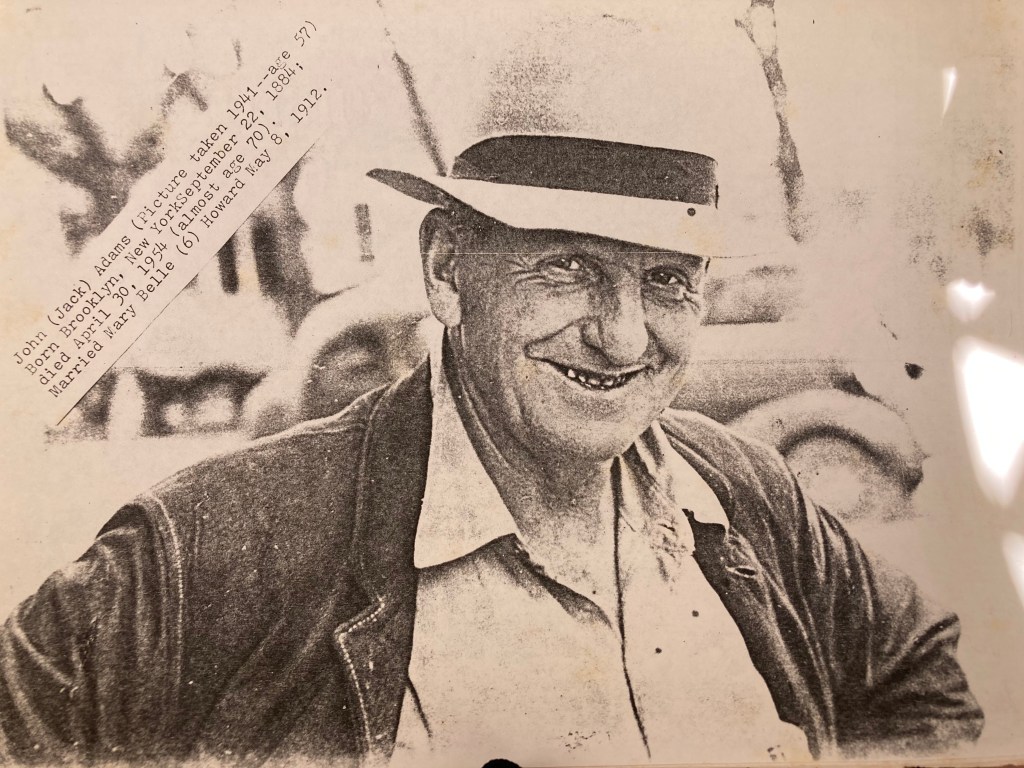
And then there’s this handsome guy. John Adams. Often called Jack. The only facts we really knew about him were there in the typed note attached to his picture. His origins were a mystery.
In another note on the same picture in another of my great Uncle Earl’s (Earl Kenneth Adams 1918-1999) genealogy books that he self published in 1989, it says, “Jack (John) Adams (September 22, 1884–April 28, 1954) Picture taken July 1941. Parents were Frank Adams and Helen (Rogers) Adams. Born Brooklyn. New York. Had a full sister named Mary. His dad married twice. Five or six half-sisters.”
Oh, and also, Adams was not his real name. He had changed it after he ran away from home and he never did tell anyone what his original name was. Well, this one old boy might have known, but he died before my uncle could ever ask him. There was speculation that he might be Jewish (That nose!), and he used to like to debate with the Catholic priest (and there’s also a receipt somewhere of his donations to the Catholic church here in Georgetown). And there was some convoluted story about someone who had known his name but couldn’t remember it, but he thought it was the same name as those folks who used to live in so-and-so’s house and so Uncle Earl actually went to the courthouse and researched the property records and the name might have been Fontaine? So French roots? Who knows.
But still, based on Earl’s note about Brooklyn and his parents Frank and Helen, every once in a while I would do a search and see what I could find. I never really turned up a likely candidate. Since he was born in 1884, and there is no U.S. Census for Brooklyn in 1890, there weren’t many possible records to search. And searches of the 1900 census for New York turned up lots of Adams families all over the state, but none that had a John who was the right age, or if he was, I could trace him forward to a marriage and a family that weren’t mine.
But there was this one kid. In the 1900 census for New York, in the Burrough of Manhattan, an inmate in The New York House of Refuge, Randall’s Island. Well, that had to be investigated.
My trip down the rabbit hole of the social reform movements of the mid to late 19th century, eventually led me to this website: https://newyorkjuvenileasylum.com/.
There are extensive records for the New York House of Refuge, including individual inmate records that detail their time there, and admission and discharge records that might include information about their family. The records have been digitized and are available on microfilm from the New York State Archive, but there are 350 volumes of material, so I decided to wait until I could afford to have Mr. Clark Kidder, at the above website, do the research for me. I had to wait until last fall, when my genealogy budget could accommodate his research fees, but boy, was it worth it!
It turned out there were two boys of approximately the right age named John Adams, but further research showed that they did not match my John Adams. But then Mr. Kidder went the extra mile. I had provided what few details I had, including the fact that Adams might not be his birth name, so he searched on just the birth date. And he found this:
Hi Toya,
In addition to what I sent previously, the closest I can find is the following boy that had the same date and year of birth, was born in Brooklyn, and had a father named Frank:
John Aubrey Born: 22 Sept. 1884 in NYC Resided: 13 Center St., Brooklyn, NY Father: Frank Father’s occupation: Watchman Father’s Nationality: French Mother’s Nationality: Irish Mother: Dead Stepmother: Ellen 3 boys and 1 girl in the family
This looked promising!
I searched for the family in Brooklyn in the 1900 census and found them in Red Hook with 7 kids. I also found all kinds of records for them, including a death record for his dad, Frank, in 1902, just a little over a year after John is discharged from the House of Refuge.
But I still wasn’t sure if I could connect this kid to my Jack Adams. I had started building out their family tree when it occurred to me that I ought to check my DNA results to see if we actually had any French ancestry on my mom’s side of the family. I knew there was a little bit, but I thought it was on my dad’s side. But lo and behold, all the French ancestry was on Mom’s side! And then, I think my heart actually stopped. One of the DNA cousin matches who is related to me and my aunt and my Adams cousins had a very limited family tree attached to her account, which included as her grandfather one of those 7 kids from the 1900 census record! I was gobsmacked. After all this time, there he was. With his real name. And his birth family. It felt like I was on an episode of Finding Your Roots.
Of course, now that I have this answer, I have a bazillion more questions. I still don’t know his birth mother’s name or when she died or where in Ireland she came from. I can’t find any other records about his father before 1900, other than a naturalization petition index record from 1895 that shows he arrived from France on 15 May 1875. But which part of France. And at almost 30 years old, was he single when he came? or is there another family that came before Jack and his mother. And what about the sisters? Lots to do!
Join us next time for another episode of Chasing Swedes (and other ancestors of varying ethnicities).
So the family lore was that Uncle Fred Brewster, who was reportedly a bit of a character, used to introduce himself to people by saying, after he shook their hand, “You just shook the hand of the man that shook the hand of the man that shook the hand of Abraham Lincoln.” My grandfather, Frank Sanders, Sr., used to do the same thing, only with an added “shook the hand of the man.” And my dad, Frank, Jr., will walk up to people and just say, “Shake” and then do the “shook the hand of the man” litany.
According to my dad and his brother, they weren’t sure who exactly it was who shook the hand of Abraham Lincoln or any of the details as to why he got to shake President Lincoln’s hand. Was it just at some campaign stop? Something to do with his army service? Was someone big into politics? Did they work in Washington? Didn’t really seem likely. This branch of the family was deeply entrenched in far northwestern Pennsylvania and not prone to going far from home (at least in these generations).
When my dad started doing genealogy research in earnest a few years ago, he stumbled across aRootsweb site about my 4xs great grandfather Mathews Harrington (1782-1864), which included the following story:
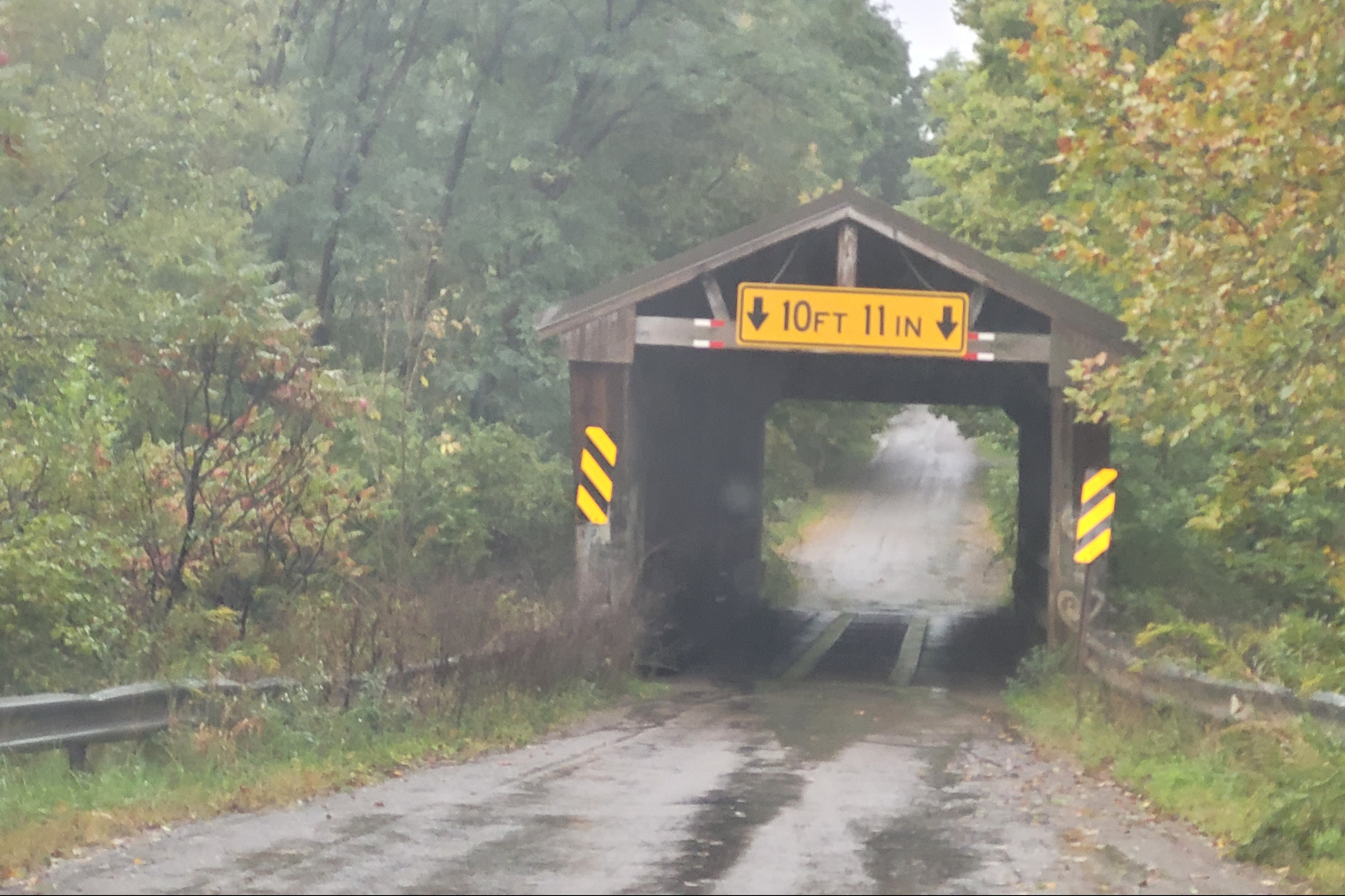
UNCLE WILLIAM VISITS WITH ABRAHAM LINCOLN Uncle William Harrington lived about 1 1/2 miles west of Pennside and the place was known as the Harrington neighborhood. Since his brothers settled on or near Cherry Hill, for some reason he obtained a tract of land on Conneaut Creek and the bridge at that point is still officially called Harrington bridge [pictured above, from our 2022 road trip through Pennsylvania]. Near the bridge was the school house designated as the Harrington school. Matthews Harrington settled at Cherry Hill but the area in which his son William lived became the Harrington neighborhood. William was the father of four sons. Ira P., named for his Uncle Ira, and called by the family little Ira, lived in the house that today is the Albion Vets Club. John and Milt remained in the neighborhood and Judd, who owned and ran the grist mill at Cherry Hill. John was the only son of William to enlist in the Union army during the wad between the states. While in camp a message was recieved by his parents, that he was very sick. His mother was so concerned about her soldier son that she could not sleep and being a large women the bed shook all night with her sobs. Finally toward morning she said, “William, you are going to go to Washington tomorrow and see President Lincoln and get John out of the army. Bring him home so that I can take care of him.” William, thinking that she had worried so much that she lost her mind, agreed with her and went to sleep. The next morning she called him early and beside the bed was his swallow tail suite and his plug hat, and on the floor his best shoes shined up. She said, “Get up and get dressed adn eat your breakfast. Judd is hitching up the horse out back to take you to Albion to the train.” After getting aboard the train at Albion he began to think, who am I that I should trouble the President of the U.S. with my affairs. I will just get off the train at Pennside and go home. But for some reason he did not give up his mission and all day and all night he stayed on that train. And early in the day he arrived in the Capitol City. He found his way to the White House and seeing no one about walked around towards the stable. The person he saw was a negro sitting by the barn. He said, “I was tickled to see anyone, black or white.” He asked the man, “Where can I find President Lincoln?” The reply that he got was, “See dat path around de stable? Jes fellow dat path till you comes to de ribber. Down by de ribber you will see a great big rock. And on dat rock you will see a big tall man settin. Dat man am Abraham Lincoln, President ob the United States.” Following the path as directed and when he approached the man he had misgivings of his worthiness to trouble him with his request. As he hesitated the tall man on the rock turned and spoke to him. Uncle William intrduced himself and they soon were holding an interesting conversation. Being men of similar background, they undoubtedly found much to talk about. In fact Uncle William did not mention the errand that had brought him to Washington. Finally the President said, “Mr. Harrington, is there something I can do for your?” Being told the purpose of his visit to Washington, Mr. Lincoln said, “I don’t know if I can do anything for you. That is a matter for the War Department to decide. If you will come to my office this afternoon at two o’clock I will know if I can get your sons discharge.” At the appointed time Uncle William wa at the President’s office. A few minutes later a man came from the inner office and said, “Mr. Harrington: The President will see you now.” He was taken into the inner office to be greated like an old friend. The discharge papers had been prepared and were given to the visitor. The President said, “Now Mr. Harrington: Take this paper to the army camp and get your son, and take him home where his mother may nurse him back to health.” When you visit the Capitol go down to the Lincoln Memorial and stand in that silent, sacred spot and experience the feeling of awe that comes to all visitors, in the presence of the graven likeness of one of our greatest Americans. Then stop and reflect on how you would have felt, if not far from that spot you would have had the opportunity of speaking to that great man in the flesh. And surely you will say to yourself, I do not wonder that Uncle William felt unworthy to bring his petition to Abraham Lincoln.
So it was Uncle William Harrington who shook the hand of Abraham Lincoln! Crazypants, man!
Just so you have the rest of the story, John’s biographical sketch is included in Samuel Bates’ “History of Erie County, Pennsylvania Containing a History of the County; its Townships, Towns, Villages, Schools, Churches, Industries, etc.; Portraits of Early Settlers and Prominent Men; Biographies; History of Pennsylvania, Statistical and Miscellaneous Matter, Etc. Etc.” Chicago: Warner, Beers & Co., 1884, p. 19 in Township (Conneaut) Biographies. (It can be found here, where you can also see his brother’s bio just about his, and his grandfather’s on the previous page. It looks like his brother Ira also served during the Civil War. Don’t know why the above story asserts that John was the only one.)
JOHN HARRINGTON, farmer, P.O. Keepville, was born September 6, 1835, in Conneaut Township, Erie County, Penn., son of William Harrington, also a native of Erie County, dying January 31, 1881. Our subject is a brother of Ira P. Harrington, whose biography appears elsewhere in this work. Mr. John Harrington was united in marriage, October 23, 1859, to Miss Mary, daughter of William Kinney, formerly of Crawford County, Penn. Seven children have crowned this union, viz., Alice A., Mark W., Maggie, Millie, Josie, Frankie, and John R. Mr. Harrington enlisted during the late war, August, 1861, in Company A, One Hundred and Forty-fifth Pennsylvania Volunteers, and served in the Second Army Corps under Gen. Hancock, with the Army of the Potomac. After serving about a year, he was honorably discharged on account of disability, caused by disease contracted in the army. He is the owner of about one hundred acres of fine land, with nice buildings. He is a Republican in politics, and is one of the substantial men of Conneaut Township, in which he has served as Township Auditor one term, and now as Road Commissioner. His grandfather Harrington, was a soldier in the war of 1812, and assisted in getting Perry’s fleet over the bar at Erie.
I love these biographical sketches. It’s fascinating to me the details they decide to include in however many words they were allotted. List of kids, Army service, and don’t forget to mention that grandfather helped Commodore Perry win the War of 1812 (but that’s a whole other story).
Finally, I will mention (mostly so I remember that I figured this out and don’t have to go back to the family tree to find him) that Uncle Fred Brewster (1851-?) was married to Mary Leone Devereaux(1851-?), half sister to my great-great grandmother Jane Devereaux (1841-1889). Their father was William Case Devereaux (1811-1879). Jane’s mother was Mary Harrington (1814-1843), whose brother was William Harrington (1805-1881). And the formidable Mrs. Harrington, who packed William onto the train and sent him to Washington, was the former Miss Jane Porter (1813-1880).
Feel free to shake my hand if you’d like to shake the hand of someone five times removed from shaking the hand of Mr. Lincoln. Next time I’m in Washington, I will go to that solemn memorial and tell him thanks.












 So the family lore was that Uncle Fred Brewster, who was reportedly a bit of a character, used to introduce himself to people by saying, after he shook their hand, “You just shook the hand of the man that shook the hand of the man that shook the hand of Abraham Lincoln.” My grandfather, Frank Sanders, Sr., used to do the same thing, only with an added “shook the hand of the man.” And my dad, Frank, Jr., will walk up to people and just say, “Shake” and then do the “shook the hand of the man” litany.
 Chasing Swedes