Birthdays in July

The Sandberg Cousins have a number of birthdays to celebrate in July. If we were all together on the 3rd Wednesday in July (which is my birthday, I will just mention), as I hope we will be soon, we could wish each other a happy day. I would attempt to list all the rest of y’all here, but I’m sure I would leave somebody out. I am a family genealogist. I keep track of the dead people, but I’m not so good about keeping up with the live people.

Jonas Christersson

12 July, 1814 – 4 January 1901
But today is an important day for us Sandberg cousins. 207 years ago today Jonas Christersson was born in a little place called Stenseryd Mellangård, in the parish of Forserum, located in the county of Jönköping, in Sweden. He was the youngest of nine children, six of whom lived to adulthood. He was actually the second Jonas, the first one having died at age 13 the year before our Jonas was born.

In 1838, Jonas married Maja Lena Svensdotter and by 1851 they had 4 children. In 1853, when Jonas was 39 years old and Maja Lena was 42, they made the decision to pack up their belongings and emigrate with the 4 kids till America. I would love to know what prompted them to make that decision. It was only 5 years before, in 1848, that S. M. Swenson convinced a group of 25 folks from Forserum and Barkeryd to travel back to America with him. This group included his mother, some of her brothers and their families, and young men and women, most of whom were related in some way to Swenson.

In the next 4 years, only one other young man and one family, also with four children, left the small village of Forserum for the promise of America. By the time of the 1860 U.S. Census (which, incidentally, is the year that Jonas bought the property near the corner of 1460 and University Ave (Chandler Rd) just south of Georgetown), there were approximately 60 people in Travis and Williamson counties who listed Sweden as their place of birth. Of the 32 Swedes living in Williamson County, most belonged to 6 families:

  • The Palms, relatives of Swenson’s, who came with the original group in 1848
  • The Heards, also part of the group from ’48,
  • The Christerssons, who came in 1853,
  • The Munsons, who also came in ’53,
  • Larsons, who came in 1854 (and I recently found out Mr. Larson was actually a nephew of Jonas’ and the older brother of the Larson nephew who was Waldine’s grandfather, but I digress.),
  • And the Nelsons, who also came in ’54.

What must it have been like to come to this wild country? Of the just over 3600 people living in the confines of Williamson county in the 1860 census, they were most likely the only ones who spoke Swedish. They didn’t have an established church for almost another twenty years, and unless they did things backwards in those days, the Christerssons would just be breaking ground on their new property at the time the census was taken that summer. Jonas would have been 46 years old.

Speaking of that summer, our beloved Hedda would have turned 16. Tomorrow, July 13th, would have been her 177th birthday.

Hedda Christina Christersson

13 July 1844 – 13 Dec 1916

Anders Wilhelm Magnusson Sandberg

26 July 1849 – 8 April 1894


And for those of you planning out the rest of your month, don’t forget to mark July 26th to celebrate Anders Wilhelm, our A.W., who gave us the Sandberg name (but I still don’t know when or why).

I’ll devote more time to Hedda and A.W. in future posts, but for today, my dear cousins, raise your coffee cups in celebration and remembrance of our original Swedish-Americans, without whom we might not be here, much less have a reason to gather once a month.

John Carlson’s Story – Part 1

or What Happened to Anna Lena?

My 3rd-great-aunt Anna Lena turned 13 on her family’s journey to America in 1853. She was listed with the family on the passenger list when they landed at Boston on September 20, 1853, but not listed with the family on the 1860 US Census in Williamson County, Texas. The one clue I had as to her fate was a mention on page 181 in Swedes in Texas in Words and Pictures, 1838-1918: English Translation that listed the children of Jonas and Maja Lena Christerson, my 3rd-great-grandparents:


Their children were Mrs. Sandberg, formerly married to Mr. Mercer, Mrs. C. J. Carlson, Mathilda, Mrs. J. Larson, and there was also a son named August.


Mrs. Sandberg is my great-great grandmother Hedda. Mathilda was a younger sister who died in 1870. Mrs. J. Larson was the youngest daughter, born after they got to Texas. So that left Mrs. C.J. Carlson as the only possibility for Aunt Anna Lena.

But I could never find a trace of this C.J. Carlson. There are only 150 individuals enumerated in the state of Texas in the 1860 U.S. Census who were born in Sweden and there aren’t any individuals with the surname Carlson in the entire state of Texas.

There were other tantalizing clues, though.

From page 177 of the Swedes in Texas, in the story of the family of Arvid Nelson:


Their son, August, met a tragic death soon after the Civil War. He was shot to death by C. J. Carlson, a former union soldier.


Was this the same C. J.Carlson?

And from The Swedish Texans, by Larry E. Scott:


Shortly after the war August Nelson was called to testify in a case against a former Union soldier, one C.J. Carlson (also a Swede), in Georgetown. One source says that Carlson was on trial for horse theft, a serious crime indeed. Nelson aroused Carlson’s enmity because of his testimony in court, and Carlson swore revenge. On the steps of the courthouse he shot Nelson in the back. August Nelson died on June 14, 1866.


So had Aunt Anna Lena married an honest to goodness scoundrel? A horse thief who would shoot a man in the back? What in the world was the actual story behind these vague accounts. Well, one night, in my ramblings around the interwebs, I happened to hit on just the right search terms and found a transcription of a newspaper article in an early Austin paper called the Southern Intelligencer, from May 24, 1866 (which I was later able to find this digital image of thanks to the Portal to Texas History):


southernintelligencer24may1866-Killed-cropped2


KILLED – On Thursday last, John Carlson and August Neilson, neighbors living on Brushy Creek in Williamson County, had a difficulty at Carlson’s house which resulted in the killing of Neilson, who was shot through the head causing instant death. It seems there was an old feud between the parties dating back to the conscript laws during the war. Neilson was a secessionist and was active in having Carlson conscripted, when the latter fled the country and joined the Texas U.S. Cavalry, whilst Neilson went into the rebel service. Since their return home the old quarrel has been renewed with the fatal result above recorded. The matter will undergo investigation, and we forbear comment. But it is proper to ask if these scenes cannot be stopped. We shall have something hereafter to say on this subject.


Wow. So his name was John Carlson? Not C. J.? And the incident occurred at Carlson’s house, rather than the courthouse steps. And he shot him in the head, rather than in the back. And not a thing about horse thieving. I am only slightly disappointed, and mostly relieved for Aunt Anna Lena’s sake, that she didn’t make an imprudent marriage. But I’m still going to refer to him as “Our murdering horse thief.” You cain’t stop me.

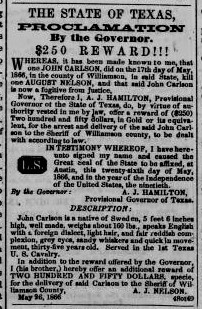
And then on page 3 of the following week’s Southern Intelligencer, May 31,1866, There appears this notice:


southernintelligencer31may1866-reward-cropped

$250 REWARD!!! An actual fugitive from justice! Now we’re talkin’! Plus I especially love the description:


John Carlson is a native of Sweden, 5 feet 6 inches high, well made, weighs about 160 lbs., speaks English with a foreign dialect, light hair and fair reddish complexion, grey eyes, sandy whiskers and quick in movement, thirty-five years old. Served in the 1st Texas U. S. Cavalry.


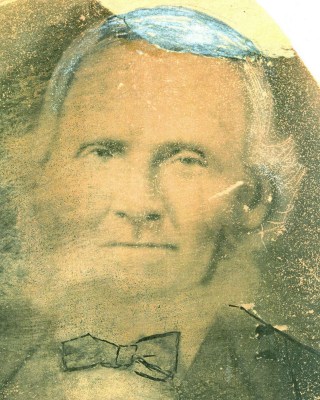
This is as close as I’ve got to a picture of John Carlson. I’d love to one day find a photo of him and of Aunt Anna Lena, but in the meantime this will have to do.

Well, I think we’ll leave it there for today. In our next installment, we’ll discover John and Anna Lena in Missouri in 1870, with three kids and John’s father and sister also in the household. And we’ll wonder why, in 1880, Anna Lena is the head of household in Missouri (with 6 kids, 4 boarders and 1 servant), but we find John Carlson living in Huntsville, Texas. What could that possibly mean?


Lies, Lies and More Lies

 “Jonas Christiernson and his wife, Maria Hilma, came to Texas in the 1850’s with the help of the Palms, and they settled on the north side of A. J. Nelson’s homestead in the Brushy settlement. Jonas Christiernson, who had been deferred from military service because of a physical handicap, was allowed to stay home on the farm. The couple belonged to the Palm Valley Lutheran congregation. Mrs. Christiernson died in 1884 and her husband in 1891. Their children were Mrs. Sandberg, formerly married to Mr. Mercer, Mrs. C. J. Carlson, Mathilda, Mrs. J. Larson, and there was also a son named August. All the children are now dead. The two older ones, Mathilda and August, are buried in the Palm Valley cemetery.”

Swedes in Texas in Words and Pictures, 1838-1918: English Translation

While the Swedes in Texas in Words and Pictures is arguably the most important resource available for those of us descended from the Swedes who settled in the area around Central Texas, it is frustratingly full of half-truths, vague references, incorrect information, and questionable data. The above paragraph about my great-great-great-grandparents Jonas and Maja Lena Christerson, from the section entitled “The First Swedes in Texas,” contains the following errors in order of appearance:


  • Christiernson is not the correct spelling of their name. Their name is spelled three different ways, that I have found, within the book – Christerson, Kristerson, and Christienson
  • Maria Hilma is not my great-great-great-grandmother’s name. It’s close, but her name was Maja Lena. Maria is the equivalent of Maja, but Hilma is not quite the same as Lena. I’m kind of quibbling here, but it always bugs me when they don’t get a name quite right.
  • “…they settled on the north side of A. J. Nelson’s homestead in the Brushy settlement.”– This is sort of true. Jonas Christerson and A.J Nelson bought their properties in the Brushy settlement on the same day in 1860. And the Nelson’s arrived in 1854, one year after the Christersons, who arrived in 1853. Now I really am quibbling, but it has always bothered me that the Nelson family, who had 2 sons who were later very prosperous, always seem to get the headlines while Jonas and Maja Lena, who had four daughters and one son who died young with no children, barely get a mention in the discussion of early settlers. Granted, this book is written a full 65 years after they emigrated, but it always surprises me how quickly these details are lost in the telling.
  • “…deferred from military service because of a physical handicap.”– Not an error, but this is that vagueness I’m talking about. Wish I had more details about this little tidbit. I haven’t found any other mention of Jonas having a handicap in any of my research.
  • “Their children were…” Just a general rant here about only referring to a married woman by her husband’s name – 50% feminist, 50% frustrated genealogist. It is lucky that I had the online resources to track down their birth records in Sweden, or I might have had some real difficulty sorting out who these sisters were.
  • C.J. Carlson – I was like a dog with a bone about this one. I could not find anything about a C.J. Carlson anywhere. Turns out his name was not C.J. it was John. And that uncovered a whole saga that I will have to dole out to you in installments at some future date. Key an eye out for posts about our murdering horse thief. It’s quite the story.
  • “The two older ones, Mathilda and August, are buried in the Palm Valley cemetery.” – Mathilda and August were not older. They were child number four and two respectively. And only August is buried in the Palm Valley cemetery. I finally found Mathilda buried in the Oakwood Cemetery in Austin, Texas, presumably because she was visiting her sister Hedda (that’s Mrs. Sandberg above, my great-great-grandmother who lived in Austin at the time) when she died of consumption in 1870. It wasn’t until I found her recorded twice, in both Travis and Williamson counties, in the 1870 U.S. Census Mortality Schedules, that I even knew to look for her in Travis county.

I know that’s half the fun of doing genealogy – finding all the fun stories behind the stories. But I still get offended beyond all reasonableness when authors of these old and so very precious books just happen to spell my ancestors name wrong or get some other details confused because someone two generations removed from the actual events is telling the story as they remember it. Bless their hearts. There’s still a nugget of truth in there somewhere and you just have to chase down the actual facts in more contemporary documents and accounts. It’s what I live for. Bless my heart.


Peace over her mips.

So I was procrastinating coming up with a topic for my First Official Post by indulging a desire to figure out what happened to the parents of a cousin I’m researching when I found the above phrase. It’s funny what a faulty OCR reading of an early 20th century Swedish-American newspaper combined with Google Translate can do to the Swedish language. “Frid öfver hennes minne,” which roughly translates to “Peace be on her memory,” with one wrong letter becomes “Peace over her mips.” I guess if the letters are wrong Google Translate just starts guessing.

Just to fill you in on the rest of the story, I am currently researching Oscar Theodore Petersson Forsvall, a cousin whose great-grandfather is my 5-times-great-grandfather (Jonas Jonasson Holmberg of Byhult Södergård, Lekeryd, Jönköping, Sweden, 1747-1815). Oscar was the first of his family to emigrate, in 1881. His older sister, Christina, followed in 1887, and his parents, Peter Jonasson and Anna Catharina Jonasdotter, and his youngest sister Augusta, came in 1897. I am looking to find more evidence of his parents’ life in Texas after their emigration in 1897 at which time they were both 74 years old. I have evidence in the form of a passenger list of their departure from Göteborg on 18 August 1897, but I could find no evidence of them in census or cemetery records in Texas after that.

I was about to head out the door and start crawling around the three possible cemeteries that they could be in, which are all within 5 minutes of my house, but then I thought to look in the newspapers! One of my new favorite online haunts is the Minnesota Historical Society’s Swedish American Newspapers collection.

They have an extensive collection of the Texas Posten, Austin, Texas’ Swedish-American weekly newspaper, from 1898 – 1922. These are not all the years the paper published, but they do span a good number of years that my ancestors, et al. were active. I have been able to find a number of obituaries and other articles about family members, particularly in the 1890s, who I otherwise had very little information about (shakes fist at the fire gods who took the 1890 census).

Searching newspapers can be a frustrating, but often supremely rewarding, endeavor. The search algorithm doesn’t usually return very specific results. Unless you have a very unusual search term to use, the returns are usually a jumble of possibilities, many of which are just an instance of the surname you’re searching appearing in a list of names of those who maybe have a letter to pick up at the post office or something. But you have to look at every single one, because the one you decide to skip is the one that will contain the full column article about the murder trial of your 4-times-great-uncle who shot that guy and ran off to Missouri, or that mention of the Presbyterian minister named McClurkin who preached at your paternal great-great-grandfather Steele’s church in that little town in Pennsylvania. But those are stories for another day. And possibly another blog….

What I found today was one brief mention, in Chicago’s Svenska Amerikanaren, January 3, 1899, of the death of Peter Jonasson Forsvall, of Georgetown, Texas, 27 November 1898, 76 years old, from Lekeryd, Småland. If you’re feeling adventurous go ahead and click that link. He’s on page 7, right there in the fourth column, next to the advertisement for “Dr. Owens Elektriska Bälten.”

And I also found the very nice obituary, containing the quote for which this post is named, in the Texas Posten, for the widow Forsvall, who died on January 27, 1908, at the home of her daughter, Mrs Alfred Eklund, funeral services held at the Free Church in Brushy. Peace over her mips. (It’s on page 12, in the middle column right below the big header “Texas” if you’re curious.)

Now I will have to go look for their graves at the Free Church cemetery. Since the Georgetown Evangelical “Brushy” Free Church was founded in 1891, and the Eklunds were members, there’s a good chance Peter and Anna Catharina are there.

Note to self: figure out how to add footnotes to a blog post so that I can officially and properly cite the sources I’m using. Already spent more time on this than I intended today, but that is the definition of genealogy, at least in my world.


The Journey Begins

When I first moved back to Texas in 1995, I was lucky enough to live close to my grandmother and great-aunt and be able to visit with them often and get to know them and many of the cousins from their generation. I got to hear about what life was like growing up on “The Farm” and, since my great-aunt and uncle still lived there, I got to hear those stories in the place where they happened. I heard lots of family stories and I knew the basics about our family history, but the details about how I was related to these various other cousins was very confusing to me, so in order to try and straighten out those details in my mind, I decided to put together a simple family tree for our upcoming family reunion. And the rest, as they say, is history.