How to even begin to choose a favorite photo! I am very lucky to have had ancestors who kept scrapbooks and photo albums and even random drawers or tins full of snapshots. Most but not all are identified on the back, and I was lucky to live near enough to some of the elders who could tell me who folks were in some of the unlabeled pics.
Thanks to my genealogy hero, my great Aunt Diddie (Ruth Marie Sandberg Carlson, 1919-2013), we even have pictures of my 3rd great grandparents, Jonas and Maja Lena Christerson!
So for the purposes of this exercise, I will be featuring The Photo I Was Most Delighted To Find. I give you, Miss Izora De Wolf!
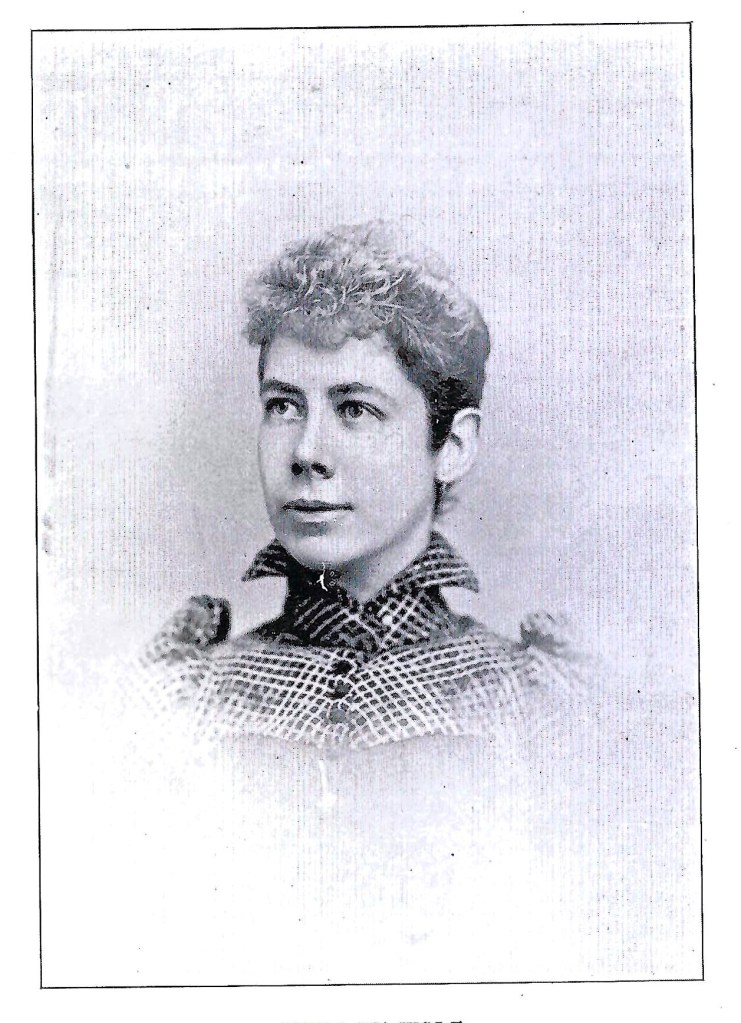
Izora is another genealogy hero of mine from my paternal side. She is my first cousin 4x removed, and the youngest of 8 daughters of my 3rd great grandaunt Catherine Harrington De Wolf and her husband William Bills De Wolf. She was born in 1853 in Conneaut Township, Erie County, Pennsylvania, but I first encountered her in the Local History collection of the Harris Elmore Public Library in Elmore, Ohio, almost 10 years ago now. There was a tantalizing mention of my 4th great grandfather (Izora’s grandfather) Mathews Harrington in the list of the collections holdings. It was just his name in this long list of items, no other details or any idea of what it might be. So the Harris Elmore Library was one of the must-see stops on our Ohio Genealogy, Quilting, and Baseball Tour of 2016. What we discovered was about 20 xeroxed, typed pages in a thin, blue report cover with a simple label on the cover that read “Mathews Harrington,” which, when opened, revealed the following lines:
REFUGITIVE FAMILY REMINISCENES
Written by Izora DeWolf, May 1913
My feet are on the western slope. It is pleasant here facing the sunset; and I walk the gently descending path cheerfully, gathering many a bright autumn flower by the wayside. But I cannot bear that those who walked before me and beside me in the morning light should disappear in the twilight shadows and pass utterly and forever from the sight of those, equally, though differently dear, who follow, and those who will follow, in our footsteps. I flinch from the thought that to the babies now in our family cradles, and the dear dream babies who shall yet lie in them, these, who were rocked in my cradle and fed at my mother’s breast, should be — just empty names, as mythical as Mercury or Diana. So I tell these simple intimate stories so simple, some of them, that, at first hearing, I fear they may seem silly to the more literal-minded of those for whom I tell them, but listening closer, I trust that some descriptive note may be found in most of them. For some I cannot make even this claim to a hearing. I just tell them because they were told to me at a age [sic] when every tale was a fairy tale and when life itself was the biggest fairy tale of all. And I somehow hate to have them laid aside and forgotten. I wonder if this fumbling explanation explains.
In those few words she had so elegantly encapsulated all the reasons why I do genealogy (and also the reason I finally determined to take on this 52 Ancestors 52 Weeks challenge!). Because even if what followed in those typed pages was far too brief, it gave flavor and life to the myriad official documents I had been able to attach to these ancestors. I knew Mathews had arrived in western Pennsylvania in about 1800, but what a treasure to have his granddaughter relate the story she had heard from him about how he walked from his home in Vermont across the frontier to “the vicinity of Cherry Hill.” And to hear my 4th great grandmother Elizabeth called by her nickname Betsey, and referred to as “in the best and true meaning of the term, a ‘strong minded woman’” is priceless. (You can click their names above if you’d like to read their stories and a pdf should open in a separate tab.)
Of course I had to research Izora and besides the usual census records and such, I discovered that she had published a book! I found her in Worldcat!
But I couldn’t find an eBook copy anywhere online and the closest library copy was in Fort Worth at the TCU Library, or maybe at the University of Oklahoma. So frustrating! But then I noticed a listing on Alibris! For a ridiculous amount of money. That I had no way to afford at the time. But, on the off chance, I sent the link to my dad with the note that this was Izora who had written the stories about Mathews and Elizabeth Spry Harrington and that, if he wanted to get it for me, it would suffice as a present for the next few birthdays and Christmases. And then I made myself forget about it.
But guess what, dear reader! Much to my astonishment, it worked! On my next birthday, Dad handed me a small, flat package, wrapped in some plain paper. I took it curiously, but then I have to admit I probably squealed and said something along the lines of, “Did you really?!?” and also, “Y’all go on with the cake and stuff, I’ll be over here in the corner with my new book…”
It is a very thin, unassuming thing. At only 46 pages, its faded deep blue covers, with their frayed edges, almost don’t create a spine. The gold lettering on the front cover is faded and of the author only the word Wolf can be readily distinguished. The inside cover has the name Zora Seely written at the top in what looks to be ballpoint pen and the facing page has a date of Dec 25th 1915 written in fountain pen. There is also evidence of cellophane tape strips which I suspect may have held a newspaper clipping? And then a page or two on there is the Introduction. Izora interviewed her brother-in-law, Andrew La Fayette Swap, in 1912 and subsequently wrote his account of his service in the Union Army from his enlistment in April of 1861 through his discharge in May of 1866 to his return home to marry Izora’s sister Loretta, whom he had corresponded with throughout the war, on September 18, 1866. Copies of daguerreotypes of both of them are included in the book.
He served in the 37th Illinois Infantry and was present at a number of “principal battles and skirmishes,” including Prairie Grove, Arkansas (7 Dec 1862) [We’ve been to walk the dogs at Battlefield Park, which is only a short drive from Sean’s aunt’s house] and Vicksburg, Mississippi (6 Jun – 4 Jul 1863), and they were sent to Brownsville Texas in the winter of 1863-64, after Union Forces took control of the Rio Grande [Small world moment: He would have been there at the same time that my maternal 2nd great-granduncle-in-law John Carlson, whom I have written about before went there from Williamson county, Texas to enlist in the Union Army. Wonder if they could have met?]
The volume also includes a collection of poems written by Izora. There is a poem opposite the introduction to A.L. Swap’s story, and then 4 poems written for Memorial Day services in 1909, 1911, 1912, and 1914, at Seven Pines National Cemetery in Henrico County, Virginia. And preceding these poems, opposite the title page, was the above picture that I was so delighted to find. What a treasure. I flatter myself I see a bit of a family resemblance.
 Chasing Swedes