 So the family lore was that Uncle Fred Brewster, who was reportedly a bit of a character, used to introduce himself to people by saying, after he shook their hand, “You just shook the hand of the man that shook the hand of the man that shook the hand of Abraham Lincoln.” My grandfather, Frank Sanders, Sr., used to do the same thing, only with an added “shook the hand of the man.” And my dad, Frank, Jr., will walk up to people and just say, “Shake” and then do the “shook the hand of the man” litany.
According to my dad and his brother, they weren’t sure who exactly it was who shook the hand of Abraham Lincoln or any of the details as to why he got to shake President Lincoln’s hand. Was it just at some campaign stop? Something to do with his army service? Was someone big into politics? Did they work in Washington? Didn’t really seem likely. This branch of the family was deeply entrenched in far northwestern Pennsylvania and not prone to going far from home (at least in these generations).
When my dad started doing genealogy research in earnest a few years ago, he stumbled across a Rootsweb site about my 4xs great grandfather Mathews Harrington (1782-1864), which included the following story:
UNCLE WILLIAM VISITS WITH ABRAHAM LINCOLN
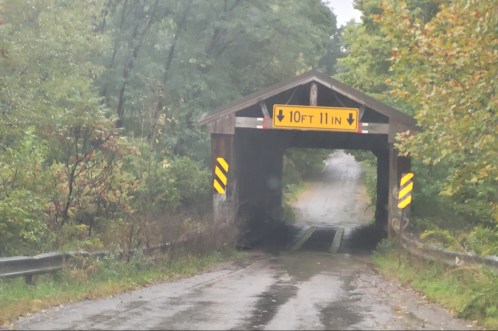
Uncle William Harrington lived about 1 1/2 miles west of Pennside and the place was known as the Harrington neighborhood. Since his brothers settled on or near Cherry Hill, for some reason he obtained a tract of land on Conneaut Creek and the bridge at that point is still officially called Harrington bridge [pictured above, from our 2022 road trip through Pennsylvania]. Near the bridge was the school house designated as the Harrington school. Matthews Harrington settled at Cherry Hill but the area in which his son William lived became the Harrington neighborhood.
William was the father of four sons. Ira P., named for his Uncle Ira, and called by the family little Ira, lived in the house that today is the Albion Vets Club. John and Milt remained in the neighborhood and Judd, who owned and ran the grist mill at Cherry Hill.
John was the only son of William to enlist in the Union army during the wad between the states. While in camp a message was recieved by his parents, that he was very sick. His mother was so concerned about her soldier son that she could not sleep and being a large women the bed shook all night with her sobs. Finally toward morning she said, “William, you are going to go to Washington tomorrow and see President Lincoln and get John out of the army. Bring him home so that I can take care of him.” William, thinking that she had worried so much that she lost her mind, agreed with her and went to sleep.
The next morning she called him early and beside the bed was his swallow tail suite and his plug hat, and on the floor his best shoes shined up. She said, “Get up and get dressed adn eat your breakfast. Judd is hitching up the horse out back to take you to Albion to the train.” After getting aboard the train at Albion he began to think, who am I that I should trouble the President of the U.S. with my affairs. I will just get off the train at Pennside and go home.
But for some reason he did not give up his mission and all day and all night he stayed on that train. And early in the day he arrived in the Capitol City. He found his way to the White House and seeing no one about walked around towards the stable. The person he saw was a negro sitting by the barn. He said, “I was tickled to see anyone, black or white.” He asked the man, “Where can I find President Lincoln?” The reply that he got was, “See dat path around de stable? Jes fellow dat path till you comes to de ribber. Down by de ribber you will see a great big rock. And on dat rock you will see a big tall man settin. Dat man am Abraham Lincoln, President ob the United States.”
Following the path as directed and when he approached the man he had misgivings of his worthiness to trouble him with his request. As he hesitated the tall man on the rock turned and spoke to him. Uncle William intrduced himself and they soon were holding an interesting conversation. Being men of similar background, they undoubtedly found much to talk about. In fact Uncle William did not mention the errand that had brought him to Washington. Finally the President said, “Mr. Harrington, is there something I can do for your?” Being told the purpose of his visit to Washington, Mr. Lincoln said, “I don’t know if I can do anything for you. That is a matter for the War Department to decide. If you will come to my office this afternoon at two o’clock I will know if I can get your sons discharge.”
At the appointed time Uncle William wa at the President’s office. A few minutes later a man came from the inner office and said, “Mr. Harrington: The President will see you now.” He was taken into the inner office to be greated like an old friend. The discharge papers had been prepared and were given to the visitor. The President said, “Now Mr. Harrington: Take this paper to the army camp and get your son, and take him home where his mother may nurse him back to health.”
When you visit the Capitol go down to the Lincoln Memorial and stand in that silent, sacred spot and experience the feeling of awe that comes to all visitors, in the presence of the graven likeness of one of our greatest Americans. Then stop and reflect on how you would have felt, if not far from that spot you would have had the opportunity of speaking to that great man in the flesh. And surely you will say to yourself, I do not wonder that Uncle William felt unworthy to bring his petition to Abraham Lincoln.
So it was Uncle William Harrington who shook the hand of Abraham Lincoln! Crazypants, man!
Just so you have the rest of the story, John’s biographical sketch is included in Samuel Bates’ “History of Erie County, Pennsylvania Containing a History of the County; its Townships, Towns, Villages, Schools, Churches, Industries, etc.; Portraits of Early Settlers and Prominent Men; Biographies; History of Pennsylvania, Statistical and Miscellaneous Matter, Etc. Etc.” Chicago: Warner, Beers & Co., 1884, p. 19 in Township (Conneaut) Biographies. (It can be found here, where you can also see his brother’s bio just about his, and his grandfather’s on the previous page. It looks like his brother Ira also served during the Civil War. Don’t know why the above story asserts that John was the only one.)
JOHN HARRINGTON, farmer, P.O. Keepville, was born September 6, 1835, in Conneaut Township, Erie County, Penn., son of William Harrington, also a native of Erie County, dying January 31, 1881. Our subject is a brother of Ira P. Harrington, whose biography appears elsewhere in this work. Mr. John Harrington was united in marriage, October 23, 1859, to Miss Mary, daughter of William Kinney, formerly of Crawford County, Penn. Seven children have crowned this union, viz., Alice A., Mark W., Maggie, Millie, Josie, Frankie, and John R. Mr. Harrington enlisted during the late war, August, 1861, in Company A, One Hundred and Forty-fifth Pennsylvania Volunteers, and served in the Second Army Corps under Gen. Hancock, with the Army of the Potomac. After serving about a year, he was honorably discharged on account of disability, caused by disease contracted in the army. He is the owner of about one hundred acres of fine land, with nice buildings. He is a Republican in politics, and is one of the substantial men of Conneaut Township, in which he has served as Township Auditor one term, and now as Road Commissioner. His grandfather Harrington, was a soldier in the war of 1812, and assisted in getting Perry’s fleet over the bar at Erie.
I love these biographical sketches. It’s fascinating to me the details they decide to include in however many words they were allotted. List of kids, Army service, and don’t forget to mention that grandfather helped Commodore Perry win the War of 1812 (but that’s a whole other story).
Finally, I will mention (mostly so I remember that I figured this out and don’t have to go back to the family tree to find him) that Uncle Fred Brewster (1851-?) was married to Mary Leone Devereaux(1851-?), half sister to my great-great grandmother Jane Devereaux (1841-1889). Their father was William Case Devereaux (1811-1879). Jane’s mother was Mary Harrington (1814-1843), whose brother was William Harrington (1805-1881). And the formidable Mrs. Harrington, who packed William onto the train and sent him to Washington, was the former Miss Jane Porter (1813-1880).
Feel free to shake my hand if you’d like to shake the hand of someone five times removed from shaking the hand of Mr. Lincoln. Next time I’m in Washington, I will go to that solemn memorial and tell him thanks.
 Chasing Swedes